With a line-up of six highly rated wines from the Left Bank of Bordeaux, we began the evening with an overview of Bordeaux appellations, the three main rivers, as well as the classifications.
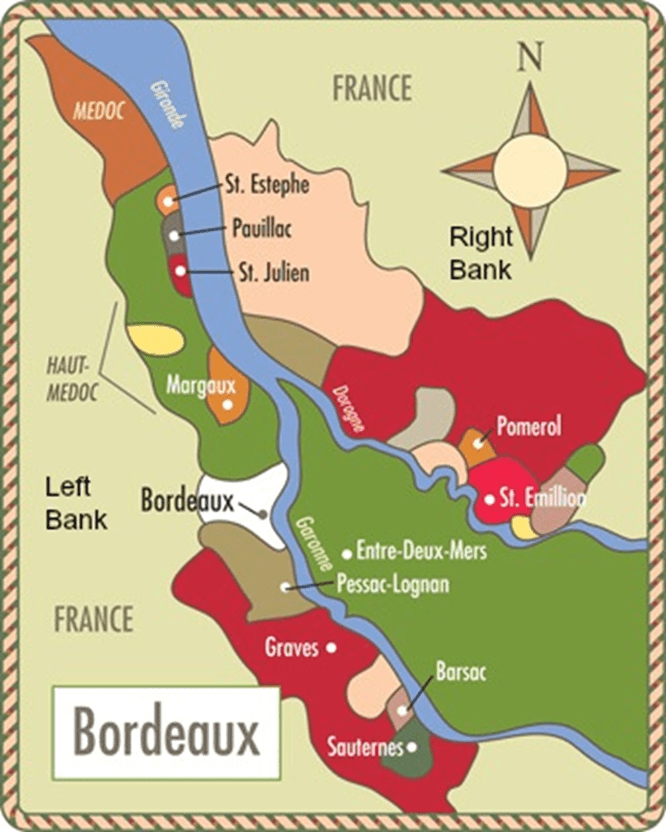
The Bordeaux Region has many moving parts…
• When talking about the Left Bank, we mean the land on the West side of the Gironde Estuary as we follow the flow of this river to the North
• The Medoc is the most Northernly AOC
• The Haut-Medoc includes the Listrac and Moulis AOCs
• From North to South, the AOCs of importance: St. Estephe, Pauillac, St. Julien, Margaux
• City of Bordeaux interrupts the Left Bank with Pessac-Leognan, Graves, and Sauternes South of the City
• Three rivers: Gironde Estuary, Garonne (for navigation to the City of Bordeaux) and the Dordogne (St. Emilion) divide the areas
• Entre-Deux Mers = land between the seas – white wine production and inexpensive red wines
• Pomerol – no official classification of Pomerol wine but the region does contain one property widely held to be equivalent to a classified growth: Chateau Petrus
• St. Emilion is a medieval, walled city on the Right Bank (Dordogne) – Merlot and Cabernet Franc – famous producer is Cheval Blanc
That’s a lot of information, but the map is simply to encourage the understanding of the area.
There are FIVE classifications in the Gironde, listed in order of seniority:
• The 1855 classification – selections all came from the Médoc, with the single exception of Haut-Brion (which also ranked Sauternes and Barsac), ranking them from first to fifth growths – this ranking remains in place today
• The Graves classification – 16 Crus, all of which belong to the AOC Pessac-Léognan (1953)
• The Saint-Émilion classification – classified in 1955 and updated every 10 years or so (Premier Grand Cru Classe ‘A’ and ‘B’, Grand Cru Classe and Grand Cru)
• The Crus Bourgeois du Médoc classification – February 20, 2020, that includes 179 Crus Bourgeois, 56 Crus Bourgeois Supérieurs and 14 Crus Bourgeois Exceptionnels
• The Crus Artisans classification – grouping of small, family run estates (that have had lots of changes over time)

While this would seem to be enough info, we then moved on to look at the profile and style of each of the Left Bank appellations for clarity:
Saint-Estephe
Profile: Dark fruits like blackberry and plum, with earthy, savory notes, and sometimes a hint of pepper. These wines are often more austere in youth with a pronounced mineral character.
Style: Full-bodied and robust with firm tannins and a notable structure. Saint-Estèphe wines often require time to soften and develop, revealing complexity and depth as they age.
Tasting: 2010 Chateau Montrose, a 2nd growth from the 1855 Classification which was awarded 100 points by Vinous, 99 by The Wine Advocate, and 98 by Decanter. A blend of 53% Cabernet Sauvignon, 37% Merlot, 9% Cabernet Franc, and 1% Petit Verdot. The wine was quite purple in the glass with aromas and flavors of pepper, licorice, black fruits, and a heady perfume aroma that lingered. With still grippy tannins and juicy acidity, the wine was balanced with a very long finish, complex, with all aspects not quite integrated indicating it is still in its youth and will continue to develop. Purchased in October 2023 for $299.
Pauillac
Profile: Black currant, cedar, graphite, tobacco, and sometimes hints of lead pencil and earth. Pauillac wines often display intense, concentrated fruit with powerful tannins.
Style: Known for its full-bodied, structured, and age-worthy elegance and complexity with a long finish. Some of the most famous and prestigious wines come from Pauillac, such as Château Lafite Rothschild, Château Latour, and Château Mouton Rothschild.
Tasting: 2010 Chateau Lynch Bages, a 5th growth from the 1855 Classification which was awarded 98 points by Jeb Dunnick and James Suckling, 97 points by Robert Parker, and 96 points by the Wine Advocate. A blend of 79% Cabernet Sauvignon, 18% Merlot, 2% Cabernet Franc, 1% Petit Verdot. The wine was purple in the glass showing aromas and flavors of tobacco, red and black fruits, graphite, baking spice, cinnamon, and anise with a mouth-filling explosion of flavors across the palate. The tannins were fine grained with high acidity supporting the very long and expressive finish. The wine was well balanced, approachable now, but elements will continue to integrate over time. A complex and outstanding wine. Purchased in October 2023 for $229.
Saint-Julien
Profile: A harmonious blend of blackcurrant, black cherry, tobacco, and earthy notes with a touch of spice. Saint-Julien wines are known for their balance and finesse.
Style: Medium to full-bodied with a velvety texture and fine tannins. Saint-Julien is often described as having the power of Pauillac and the finesse of Margaux, making it a middle ground between the two in style.
Tasting: 2010 Chateau Leoville Barton, a 2nd growth from the 1855 Classification which was awarded 100 points by Wine Enthusiast, 97 points from James Suckling, and 96 points from The Wine Advocate. A blend of 77% Cabernet Sauvignon, 21% Merlot, 2% Cabernet Franc. The wine was more ruby/purple with earthy elements of wet mulch, jam (red and black fruits), wet tobacco, licorice and white pepper. The acid was medium plus with fine tannins and restrained alcohol. The wine was balanced with a medium plus finish, complex but not yet fully integrated aromas and flavors with a bit of bitter phenolics on the finish. Purchased in October 2023 for $195.
Margaux
Profile: Floral notes of violet and rose, alongside red and black fruits like cherry and cassis. Margaux wines can also show hints of vanilla, cedar, and spice from oak aging.
Style: The most elegant and perfumed of the Médoc wines, Margaux wines are often described as silky and refined with a lighter body and softer tannins compared to other Left Bank wines. They are known for their aromatic complexity and charm.
Tasting: 2010 Pavillon Rouge, the 2nd bottling of Chateau Margaux, which was awarded 96 points by James Suckling, 94 points by Robert Parker, and 94 points by Wine Enthusiast. The blend is 66% Cabernet Sauvignon, 30% Merlot, and 4% Petit Verdot. The wine was dark ruby in color with perfume of roses and violets, very intense as you brought air across your palate. Red plum and bright cherry, ripe fruits, cedar with silky tannins and juicy acidity. The wine was balanced with good integration and complexity of flavors, with a long finish that will keep evolving. An impressive wine. Purchased in October 2023 for $269.
Haut-Medoc
Profile: Varies by producer, but typically includes red and black fruits, herbs, and a touch of earth and oak. Haut-Médoc wines can show good balance and structure.
Style: Medium-bodied with a mix of fruit and earthiness, these wines are often well-structured with moderate tannins. Haut-Médoc encompasses several smaller appellations, and while they may not reach the heights of the more prestigious communes, they offer excellent value and aging potential.
Tasting: 2010 Chateau Cantemerle, a 5th growth from the 1855 Classification. Awarded 94 points by James Suckling. The wine is a blend of 60% Cabernet Sauvignon, 30% Merlot, 6% Cabernet Franc, and 4% Petit Verdot. Purple color in the glass and opague. The aromas and flavors were more subdued as compared to others in the line-up, with notes of red and black berries and plums, a hint of phenolics from the oak used and a note of older wood. The acidity was medium plus and the tannins a tad on the coarse side. With a medium plus finish, the wine was balanced with restrained alcohol at 13%. The wine was sound, but perhaps would have been a bit more lively had it been open and consumed a year or two earlier. A solid producer from the Haut Medoc that always presents a very good wine, albeit not meant to age like a Chateau Montrose, etc., but priced at $65 when purchased in October 2023, and definitely the bargain in the line-up.
Pessac-Leognan
Profile: Red and black fruits, often with a smoky, earthy character, along with cedar, tobacco, and sometimes a note of graphite. The gravelly soils contribute to a distinctive mineral quality.
Style: Medium to full-bodied with a firm structure and refined tannins. Pessac-Léognan is known for producing wines with great complexity and depth, often showing a balance of fruit, earth, and minerality. Château Haut-Brion is a standout from this region.
Tasting: 2010 Chateau Haut Bailly, a Cru Classe from the Graves Classification. The wine was awarded 100 points from Decanter and 98 points from the Wine Advocate. The blend is 62% Cabernet Sauvignon, 36% Merlot, and 2% Cabernet Franc. The wine was quite purple in the glass with red and black fruits and notably ripe cherries, rich, with a added layer of ripe peaches, dried mulch, a whiff of smoke and graphite, with evident minerality. The acid was juicy, the wine complex and balanced with tannins presenting on the coarse side. So many interesting elements in this wine making it a real crowd pleaser. This wine should continue to age beautifully. Purchased in October 2023 for $195.
An impressive and informative tasting, allowing the comparison of wines from different appellations within Bordeaux, looking for and identifying the unique characteristics and styles, with the bonus of actually recognizing wines at different stages of maturity, while all coming from the fantastic 2010 vintage. A very good lesson in that vintage does matter.

A very fun and great learning session crafted for a Masterclass tasting of Bordeaux wines for the International Wine & Food Society.
 Sudsy's Cellar