Scale Without Sacrifice: Inside Guigal’s Côtes du Rhône

Wine professionals are routinely asked variations of the same question: what is a reliable, reasonably priced bottle for everyday drinking? In practice, the answer often points to wines that are widely available through grocery stores and large retail channels.

Côtes du Rhône frequently enters that conversation. The appellation offers accessibility and broad availability, but it also spans a wide range of production approaches. Not all producers operate with the same priorities.

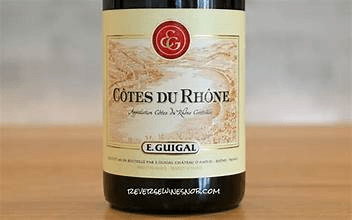
Having long found E. Guigal’s Côtes du Rhône to perform above its price point, I began to consider what distinguishes it — and how those differences show up in the glass.


A Visit That Reframed the Wine

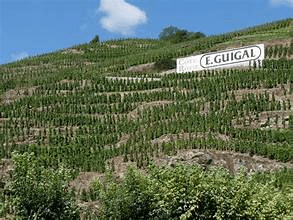
In October 2022, I stood in Ampuis tasting across the Guigal portfolio, from Côtes du Rhône through Hermitage and Côte-Rôtie.

Like many wine drinkers, I had always associated Guigal with its prestigious Côte-Rôtie bottlings — including the famed La La wines — as well as the structured expressions of the Northern Rhône.

What surprised me most that day was not the top wines.

It was the Côtes du Rhône.

The bottle most consumers encounter on grocery store shelves — often priced under twenty dollars — carried a level of structure and composure that felt distinctly connected to the house’s upper-tier wines. It did not taste like a volume-driven afterthought. It felt deliberate.

The Reality of Scale

Côtes du Rhône is one of France’s largest appellations, and supplying large retail chains requires significant volume. For many producers, the model is straightforward: maximize yields, machine harvest, ferment efficiently, and bottle early to keep inventory moving.

There is nothing inherently wrong with this approach. It produces wines that are approachable, consistent, and ready to drink.

But it is also a model built around efficiency.

Time matters. Extended aging ties up capital. Longer maceration requires labor and attention. Space in a cellar is finite. Every additional month before bottling delays revenue.

Against that backdrop, Guigal makes a different set of choices.


What Guigal Does Differently

Guigal’s Côtes du Rhône is typically led by Syrah, with Grenache and Mourvèdre playing supporting roles. That alone shapes the wine differently. Syrah brings structure, color, and aromatic lift, giving the wine a firmer backbone than many Grenache-heavy blends at this level.

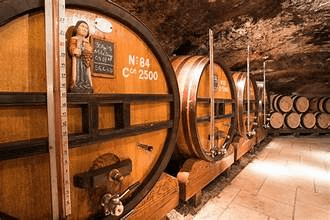
More importantly, the wine is aged for roughly eighteen months, much of it in large, seasoned oak foudres.

These large vessels don’t add obvious oak flavor. Instead, they allow the wine to evolve slowly, integrating tannins and developing texture over time. It’s a quieter influence, but an important one.

At this price point, that level of aging stands out.

It means the wine is not rushed to market. It is given time to come together.

Why It Feels Different in the Glass

When you return to the wine with this in mind, the differences become clearer.

The tannins are present but resolved. The fruit is there, but it doesn’t feel simple or one-dimensional. There’s a subtle savory edge, a sense of structure that carries through the finish.

It doesn’t just taste fruity.

It tastes complete.

That sense of integration is what often separates wines built for quick release from those given time to develop.

A Foundation, Not an Afterthought

What became clear during the tasting in Ampuis is that Guigal’s Côtes du Rhône is not treated as a separate, commercial product.

It is the foundation of the house style.

As you move up through the portfolio, the wines gain in concentration, complexity, and site expression — but they don’t feel disconnected. The same structural through-lines remain.

That continuity matters.

If the entry-level wine were simple or dilute, it would weaken the perception of everything above it. Instead, it acts as a clear introduction to how the house approaches wine.


Why This Matters on the Shelf

For consumers navigating a crowded grocery aisle, not all bottles are created equally — even within the same appellation.

Some wines are built for speed and accessibility. Others are built with a longer view, shaped by decisions that prioritize structure and integration over efficiency.

Guigal’s Côtes du Rhône shows that scale does not have to mean compromise.

It is widely available. It is reasonably priced. And yet, it reflects a set of choices that give it more shape, more balance, and more presence than many of its peers.


Final Thought

At the end of the day, the difference comes down to intent.

When a producer chooses to give even its most accessible wine time — to let it evolve, to let it settle into itself — that decision shows up in the glass.

Guigal’s Côtes du Rhône is not just an easy recommendation because of price or availability.

It’s a recommendation because it quietly delivers more than expected.

Virtual tasting via Zoom….what’s in your glass?

With SIP and not being able to wander the wine aisles, what are you buying and what are you drinking?

Personally, I love strolling the aisles in the ‘candy store’ (AKA wine shop) and touching the merchandise. It’s frustrating not being able to do so as I do a lot of reading and I always feel as if I hit the jackpot when I stumble upon a wine I have been reading about.  It’s the thrill of a treasure hunt with an unexpected silver lining. 

By using Zoom as a way of sharing a glass of wine (or a cocktail), we have been labeling our chats as a ‘virtual wine tasting.’  That puts the pressure on me to try and choose a wine to ‘share’ that will be agreeable to a broad range of palates while not losing sight of the fact that there will not be a meal to accompany the offering.  And, oh by the way, we are really using this time to ‘catch up’ with each other and actually see a human.

I could list many producers that are crafting very nice wines, and can do so over time, but today I want to introduce you to Chateau de Saint Cosme.  This is a winery in the Southern Rhone area of France that makes many different wines from various AOPs.

Imagine…an ancient estate purchased in 1570 with grape vines already on the property.  A chateau is soon constructed over the existing cellars which contained perfectly preserved Gallo-Roman fermentation vats.  The Barruol family and their ancestors have been vignerons at the property for 14 generations.

The actual property is in Gigondas with the beautiful Dentelles de Montmirail as a backdrop.  While the vines from the property surrounding the Chateau are used for their Gigondas wine, the Chateau also produces wines from Côte-Rôtie, Condrieu, St. Joseph and Châteauneuf-Du- Pape, to name just a few of their offerings.

As with many producers, the Barruol family wear many producer hats.  First, as an Estate where they grow the grapes and produce the wine.  However, they also source grapes from other growers and produce wine under the Saint Cosme (vs. the Chateau de Saint Cosme) label. 

The Saint Cosme Cotes du Rhone 2018 is an affordable and accessible offering that hits all the ‘good quality’ targets.  While it is labeled as a Cotes du Rhone wine (which generally would mean it is a GSM blend = Grenache, Syrah, Mourvèdre), this wine is 100% Syrah.  That is very appealing to me as generally, to get a 100% Syrah wine, you need to move up into the Northern Rhone at a much higher price point.  The grapes for this bottling were sourced from the right bank of the Rhone in the Gard area as well as the left bank in Vinsobres from a higher elevation.

The core of the wine is purple with aromas of violets, black cherry, black pepper and black olives.  It is medium plus in body with well-integrated, silky tannins and a very long finish.  I found it pleasant for quaffing but know how wonderful this wine is with lamb chops with rosemary and garlic mashed potatoes.

For you ‘score hounds’, the critic community agrees.  Robert Parker 90 points, Wine Enthusiast 91 points and James Suckling 91 points.

I purchased for $15 and have seen it priced in the $14 – 20 range.

While I have spotlighted just one offering from this Chateau and at the accessible rung of the marketing ladder, they are producing quality wines in all areas.  The point I am hoping to make = find a quality producer and try various wines across that brand.  Some will be accessible as this Cotes du Rhone, some with be in a stretch category that you might purchase only for special occasions and others you may never buy because of the price point.  However, in a good vintage year, you can often find wines from these producers that over-deliver quality at a reasonable price.  It is also fun to have a story to tell about the wine and winery.

I hope you enjoyed this virtual tasting…stay safe out there!

Santé

Sudsy

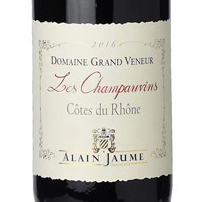
2016 Domaine Grand Veneur “Champauvins” Cotes du Rhone-Villages

I had the pleasure of tasting this bottling from Alain Jaume at an event the other night, coming back around the room and sampling it twice just to make sure. 

Hailing from the Southern Rhone, this wine is a Cotes du Rhone Villages, a step up from the generic Cotes du Rhone wines. These bottlings of ‘Villages’ are frequently found here in the US as they can represent some of the best values in the market and are priced less than a Gigondas or a Chateauneuf du Pape wine.  However, as with all wines, producers do matter and Alain Jaume delivers quality.

Visually, the wine was dark ruby in color with a solid core.  On the nose, a good dose of black cherry, blackberry, lavender, and tobacco leaf with a bit of peppery spice presented. On the palate, the wine was full bodied and concentrated with good red and black fruits and that Southern Rhone garrique element…lavender, spice and sun kissed rocks.  There are tannins present with medium acidity which helps to bring all the elements together.  The finish lingers.  A very tasty wine!

This is a GSM blend of 70% Grenache, 20% Syrah and 10% Mourvedre.  I found it locally at these sellers:

K&L Wine Merchants      $ 19.99

The Wine Steward       $ 25.99  (discount given on case sales)

Total Wine     $ 23.99  (discount given on purchase of 6 wines)

If you are looking for a rock-solid wine for the Holidays, this will deliver a lot of flavor and body at a modest price. 

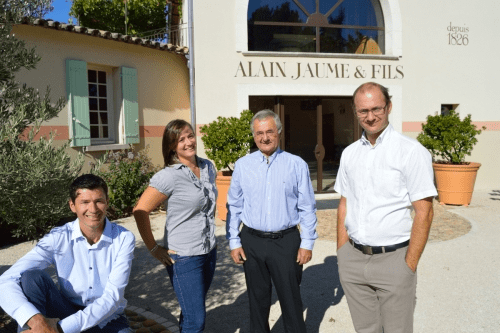
Established in the northern part of Châteauneuf-du-Pape, in the commune of Orange, the Jaume family has been dedicated to the art of wine growing since 1826. Founded by Mathieu Jaume, the Domaine is now run by the 5th and 6th generations of Jaumes: Alain Jaume & his children Christophe, Sébastien, and Hélène.

Sante!

Sudsy