Four Italian reds, one chicken dinner, and a little lesson in the magic of contrast.
By Claire L. Torbeck, DipWSET
Sometimes the most interesting wine discoveries happen when you’re not particularly looking for them.
When people think of Italian red wine, Chianti often comes to mind. But Italy has so much more to offer, and I wanted to explore some of that diversity over dinner with friends. I deliberately selected four wines made from different grape varieties, representing three Italian regions. The plan was to taste them blind, discover their different personalities, and then revisit them with the same dish to see what changed.
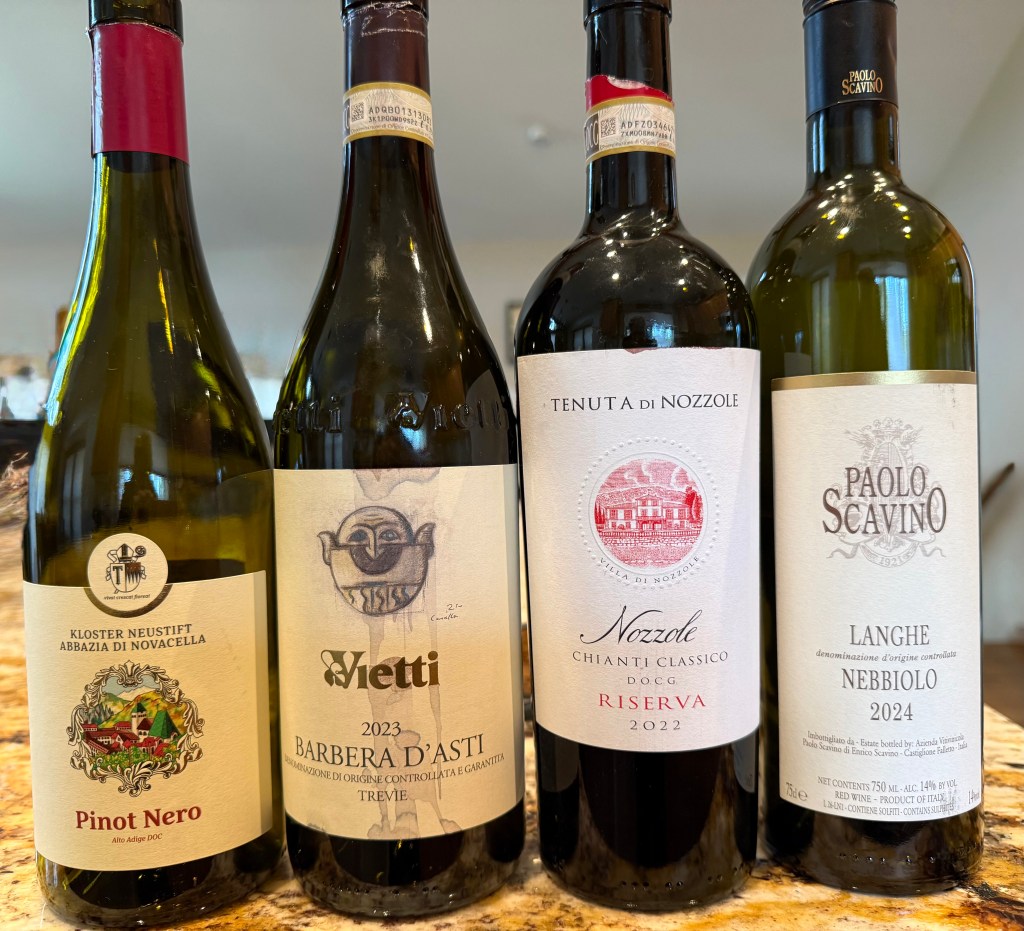
We began with Pieropan Soave Classico and appetizers before moving on to our four reds:
- 2024 Abbazia di Novacella Pinot Nero, Alto Adige
- 2023 Vietti Trevie Barbera d’Asti, Piedmont
- 2022 Tenuta di Nozzole Chianti Classico Riserva, Tuscany
- 2024 Paolo Scavino Langhe Nebbiolo, Piedmont
Four wines, four personalities, and not an expensive bottle among them. Prices ranged from approximately $23 to $31.
I wasn’t looking for a winner. I wanted everyone to experience how different wines could work with the same dish—and perhaps discover that personal preference has as much to do with successful pairing as conventional wisdom.
An Italian Twist on Coq au Vin
For dinner, I prepared boneless chicken thighs slowly braised with sautéed onions, crimini mushrooms, tomato paste, chicken broth, a little Amador County Barbera, and a few squirts of balsamic glaze. I love balsamic with mushrooms, and the small amount added depth without making the sauce sweet.
The finishing sauce was where things became particularly interesting. I separately sautéed crimini, shiitake, and oyster mushrooms in olive oil, added blistered cherry tomatoes, and incorporated some of the braising liquid, reducing it to concentrate the flavors. A little butter rounded everything out. The chicken was served with garlic mashed potatoes, thyme-roasted carrots, and a light sprinkling of freshly grated Parmigiano Reggiano.
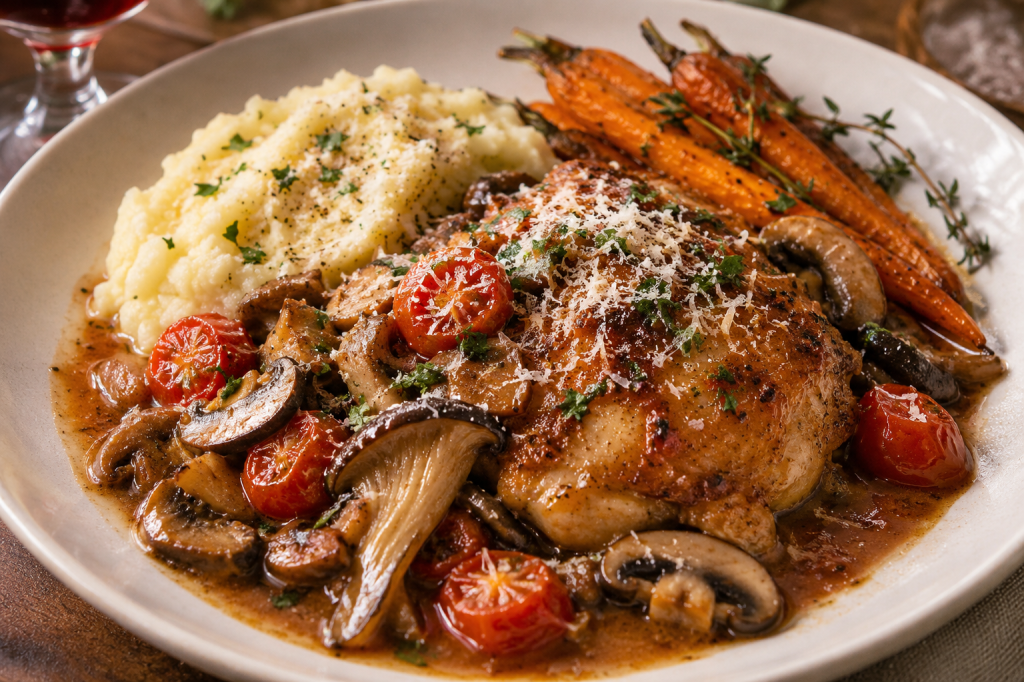
The dish turned out even better than I’d hoped. The mushrooms contributed earthy complexity, the tomatoes provided brightness, and the sauce brought everything together.
Unfortunately, I was also battling a miserable head cold and spent much of the evening blowing my nose while my gracious guests pretended this was perfectly normal behavior for a dinner hostess. Not exactly ideal conditions for evaluating wine aromas, but we persevered!
Four Wines, Four Personalities
We tasted the wines blind before dinner, recording our impressions of appearance, aromas, acidity, tannins, body, and finish.
The Pinot Nero immediately appealed to me with its fresh raspberry, earthy notes reminiscent of wet mulch, cinnamon, and spice. It had high acidity, medium tannins, and a relatively light palate impression. The Barbera was darker, more substantial, and savory, with tobacco and earthy characteristics. The Chianti Classico Riserva and Langhe Nebbiolo were fuller-bodied, with more pronounced tannic structure.
All four had good acidity, although their textures and flavor profiles were quite different. Given the tomato, mushrooms, and savory character of the dinner, I expected the Barbera and Chianti Classico to perform particularly well.
And I wasn’t wrong. But I wasn’t entirely right, either.
Then Came the Food
Every one of the four wines worked with dinner. I could have served any of them and been perfectly happy.
The Barbera and Chianti Classico were harmonious. Their acidity, savory characteristics, and fuller palate presence complemented the food nicely. But they seemed to reinforce what was already happening on the plate. The flavors and textures were compatible without offering anything particularly new.
The Nebbiolo was also very good. Its acidity brought freshness, although its fuller body and pronounced tannins gave it a substantial presence alongside an already rich dish.
And then there was the Pinot Nero.
With each bite of chicken, mushrooms, and mashed potatoes, followed by a sip of Pinot Nero, my palate seemed to come alive again. There was a lift and freshness to the combination that made me want to return for another bite and another sip. The wine didn’t compete with the food, nor did it simply echo the flavors already on the plate. It contributed something different.
Apparently, I wasn’t alone. Three of the four guests who expressed a preference chose the Pinot Nero, while one preferred the Barbera. And when it was time for a second glass, I reached for the Pinot Nero.
When Less Weight Becomes More
I’ve spent some time thinking about why this pairing was so compelling.
The mushrooms certainly played an important role. Their earthy, savory complexity connected beautifully with the Pinot Nero’s earthy undertones. That’s a complementary pairing—wine and food sharing characteristics that reinforce one another. But I don’t think that fully explains what happened.
Consider the dinner. Chicken thighs are richer than chicken breasts. Garlic mashed potatoes are creamy and substantial. Sautéed mushrooms contribute savory depth, while the reduced braising sauce adds another layer of richness. Almost everything on the plate was moving in the same direction: rich, savory, earthy, and rounded.
Now consider the Pinot Nero. It had high acidity, fresh raspberry fruit, medium tannins, and a lighter palate impression than the other wines. Rather than adding another layer of weight, it seemed to restore balance.
The Barbera also had high acidity, so acidity alone couldn’t explain the difference. Its more substantial body and savory flavor profile may have made it feel more like an extension of the dish. The Pinot Nero, on the other hand, offered both an aromatic connection to the mushrooms and a refreshing contrast to the richness of the food.
It complemented the food aromatically while contrasting with it texturally.
A little yin and yang, if you will.
Harmony Versus Excitement
We often approach wine pairing by looking for similarities. A rich dish calls for a rich wine. Earthy mushrooms suggest an earthy red. Tomato-based sauces point us toward wines with good acidity. These are useful principles, but they’re only part of the story.
Instead of asking only what wine has characteristics that match the food, perhaps we should also ask: What could the wine contribute that the food doesn’t already have?
Think about Champagne with French fries. The wine doesn’t taste like potatoes, but its acidity and bubbles provide a refreshing counterpoint to the salt and fat. Or consider sweet Sauternes with salty Roquefort, where the contrast is precisely what makes the combination so compelling.
My Pinot Nero and chicken dinner operated on a similar principle, although much more subtly. The earthy flavors connected, while the wine’s bright fruit and lighter palate weight provided contrast. It wasn’t simply about matching flavors; it was about how the wine changed the experience of eating the food.
Of course, pairing preferences are personal. Someone who enjoys a richer, more seamless combination might reasonably prefer the Barbera or Chianti Classico. All four wines were successful partners, but the Pinot Nero made the food seem more lively to me, and the food, in turn, made me appreciate the wine even more.
A Final Thought
We finished the evening with biscotti and a 2012 Vin Santo (the “holy wine”), a lovely reminder that Italy’s wine diversity extends well beyond its reds.
I’d begun the evening expecting the Barbera and Chianti Classico to be particularly successful with dinner. They were. But the wine that surprised and delighted me was a modestly priced Pinot Nero from Alto Adige—not because it was bigger, more powerful, or more complex, but because its lighter texture and fresh fruit provided exactly what I wanted alongside a rich, savory meal.
Sometimes the magic of pairing comes from similarity. Sometimes it comes from contrast. And occasionally, as with this Pinot Nero, it comes from a little of both.
That’s why I love putting several wines on the table and letting the food have its say.
You never know which bottle you’ll reach for a second time.

