When the Best Wine Pairing Isn’t the One You Expected

Four Italian reds, one chicken dinner, and a little lesson in the magic of contrast.

By Claire L. Torbeck, DipWSET

Sometimes the most interesting wine discoveries happen when you’re not particularly looking for them.

When people think of Italian red wine, Chianti often comes to mind. But Italy has so much more to offer, and I wanted to explore some of that diversity over dinner with friends. I deliberately selected four wines made from different grape varieties, representing three Italian regions. The plan was to taste them blind, discover their different personalities, and then revisit them with the same dish to see what changed.

We began with Pieropan Soave Classico and appetizers before moving on to our four reds:

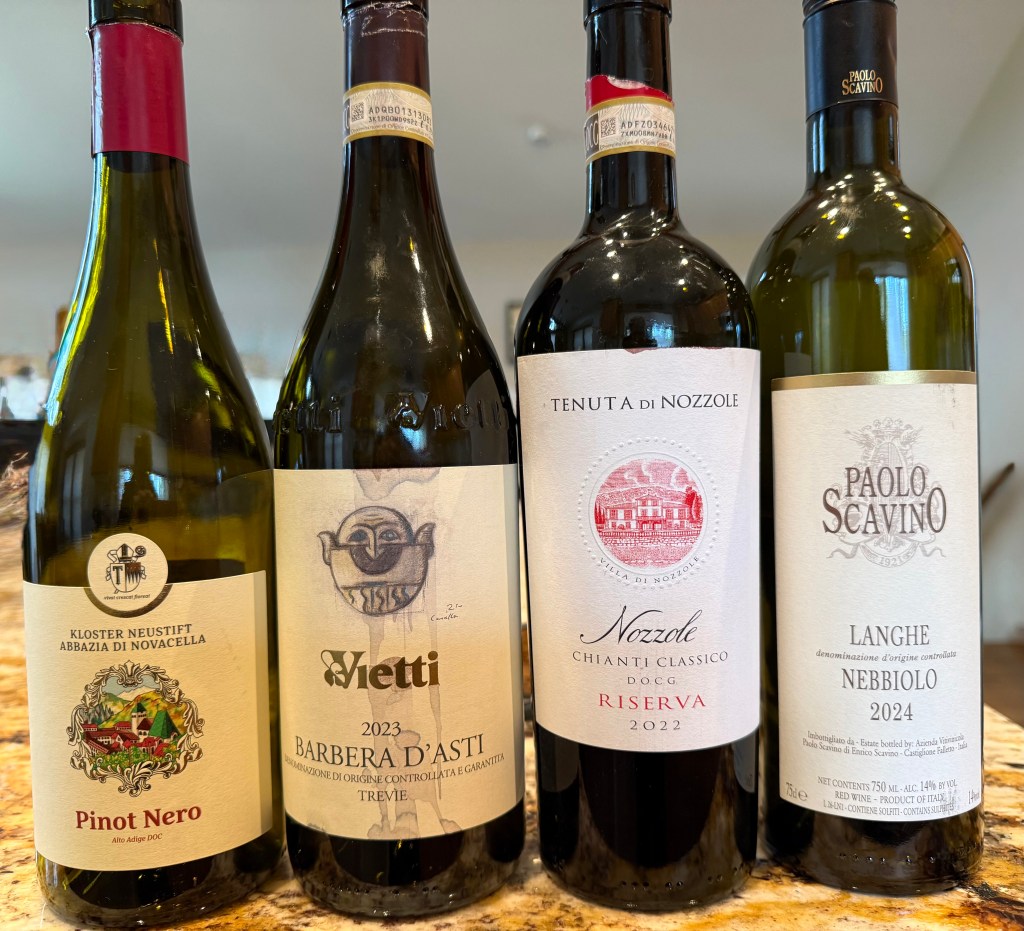
  • 2024 Abbazia di Novacella Pinot Nero, Alto Adige
  • 2023 Vietti Trevie Barbera d’Asti, Piedmont
  • 2022 Tenuta di Nozzole Chianti Classico Riserva, Tuscany
  • 2024 Paolo Scavino Langhe Nebbiolo, Piedmont

Four wines, four personalities, and not an expensive bottle among them. Prices ranged from approximately $23 to $31.
I wasn’t looking for a winner. I wanted everyone to experience how different wines could work with the same dish—and perhaps discover that personal preference has as much to do with successful pairing as conventional wisdom.

An Italian Twist on Coq au Vin

For dinner, I prepared boneless chicken thighs slowly braised with sautéed onions, crimini mushrooms, tomato paste, chicken broth, a little Amador County Barbera, and a few squirts of balsamic glaze. I love balsamic with mushrooms, and the small amount added depth without making the sauce sweet.

The finishing sauce was where things became particularly interesting. I separately sautéed crimini, shiitake, and oyster mushrooms in olive oil, added blistered cherry tomatoes, and incorporated some of the braising liquid, reducing it to concentrate the flavors. A little butter rounded everything out. The chicken was served with garlic mashed potatoes, thyme-roasted carrots, and a light sprinkling of freshly grated Parmigiano Reggiano.
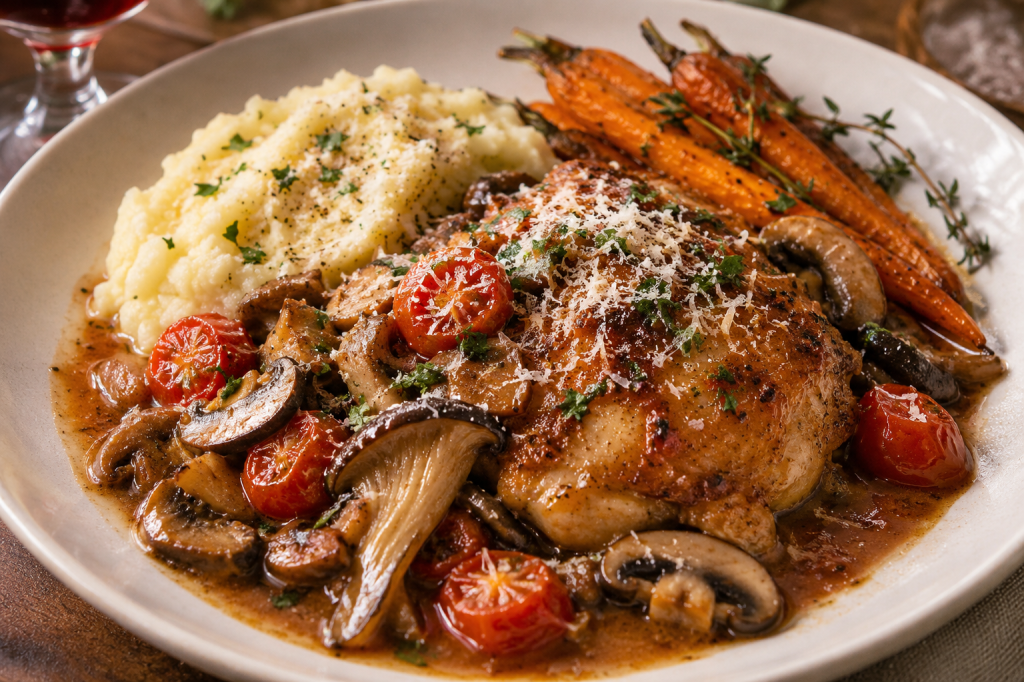
The dish turned out even better than I’d hoped. The mushrooms contributed earthy complexity, the tomatoes provided brightness, and the sauce brought everything together.

Unfortunately, I was also battling a miserable head cold and spent much of the evening blowing my nose while my gracious guests pretended this was perfectly normal behavior for a dinner hostess. Not exactly ideal conditions for evaluating wine aromas, but we persevered!

Four Wines, Four Personalities

We tasted the wines blind before dinner, recording our impressions of appearance, aromas, acidity, tannins, body, and finish.

The Pinot Nero immediately appealed to me with its fresh raspberry, earthy notes reminiscent of wet mulch, cinnamon, and spice. It had high acidity, medium tannins, and a relatively light palate impression. The Barbera was darker, more substantial, and savory, with tobacco and earthy characteristics. The Chianti Classico Riserva and Langhe Nebbiolo were fuller-bodied, with more pronounced tannic structure.

All four had good acidity, although their textures and flavor profiles were quite different. Given the tomato, mushrooms, and savory character of the dinner, I expected the Barbera and Chianti Classico to perform particularly well.

And I wasn’t wrong. But I wasn’t entirely right, either.

Then Came the Food

Every one of the four wines worked with dinner. I could have served any of them and been perfectly happy.

The Barbera and Chianti Classico were harmonious. Their acidity, savory characteristics, and fuller palate presence complemented the food nicely. But they seemed to reinforce what was already happening on the plate. The flavors and textures were compatible without offering anything particularly new.

The Nebbiolo was also very good. Its acidity brought freshness, although its fuller body and pronounced tannins gave it a substantial presence alongside an already rich dish.

And then there was the Pinot Nero.

With each bite of chicken, mushrooms, and mashed potatoes, followed by a sip of Pinot Nero, my palate seemed to come alive again. There was a lift and freshness to the combination that made me want to return for another bite and another sip. The wine didn’t compete with the food, nor did it simply echo the flavors already on the plate. It contributed something different.

Apparently, I wasn’t alone. Three of the four guests who expressed a preference chose the Pinot Nero, while one preferred the Barbera. And when it was time for a second glass, I reached for the Pinot Nero.

When Less Weight Becomes More

I’ve spent some time thinking about why this pairing was so compelling.

The mushrooms certainly played an important role. Their earthy, savory complexity connected beautifully with the Pinot Nero’s earthy undertones. That’s a complementary pairing—wine and food sharing characteristics that reinforce one another. But I don’t think that fully explains what happened.

Consider the dinner. Chicken thighs are richer than chicken breasts. Garlic mashed potatoes are creamy and substantial. Sautéed mushrooms contribute savory depth, while the reduced braising sauce adds another layer of richness. Almost everything on the plate was moving in the same direction: rich, savory, earthy, and rounded.

Now consider the Pinot Nero. It had high acidity, fresh raspberry fruit, medium tannins, and a lighter palate impression than the other wines. Rather than adding another layer of weight, it seemed to restore balance.

The Barbera also had high acidity, so acidity alone couldn’t explain the difference. Its more substantial body and savory flavor profile may have made it feel more like an extension of the dish. The Pinot Nero, on the other hand, offered both an aromatic connection to the mushrooms and a refreshing contrast to the richness of the food.

It complemented the food aromatically while contrasting with it texturally.

A little yin and yang, if you will.

Harmony Versus Excitement

We often approach wine pairing by looking for similarities. A rich dish calls for a rich wine. Earthy mushrooms suggest an earthy red. Tomato-based sauces point us toward wines with good acidity. These are useful principles, but they’re only part of the story.

Instead of asking only what wine has characteristics that match the food, perhaps we should also ask: What could the wine contribute that the food doesn’t already have?

Think about Champagne with French fries. The wine doesn’t taste like potatoes, but its acidity and bubbles provide a refreshing counterpoint to the salt and fat. Or consider sweet Sauternes with salty Roquefort, where the contrast is precisely what makes the combination so compelling.

My Pinot Nero and chicken dinner operated on a similar principle, although much more subtly. The earthy flavors connected, while the wine’s bright fruit and lighter palate weight provided contrast. It wasn’t simply about matching flavors; it was about how the wine changed the experience of eating the food.

Of course, pairing preferences are personal. Someone who enjoys a richer, more seamless combination might reasonably prefer the Barbera or Chianti Classico. All four wines were successful partners, but the Pinot Nero made the food seem more lively to me, and the food, in turn, made me appreciate the wine even more.

A Final Thought

We finished the evening with biscotti and a 2012 Vin Santo (the “holy wine”), a lovely reminder that Italy’s wine diversity extends well beyond its reds.

I’d begun the evening expecting the Barbera and Chianti Classico to be particularly successful with dinner. They were. But the wine that surprised and delighted me was a modestly priced Pinot Nero from Alto Adige—not because it was bigger, more powerful, or more complex, but because its lighter texture and fresh fruit provided exactly what I wanted alongside a rich, savory meal.

Sometimes the magic of pairing comes from similarity. Sometimes it comes from contrast. And occasionally, as with this Pinot Nero, it comes from a little of both.

That’s why I love putting several wines on the table and letting the food have its say.

You never know which bottle you’ll reach for a second time.

Exploring Tre Bicchieri: Italy’s Top Wine Awards and Tastings

Tre Bicchieri is one of Italy’s most prestigious wine awards, given by the renowned Italian wine guide Gambero Rosso. The term translates to “three glasses,” signifying wines that stand out for their exceptional quality. Each year, Gambero Rosso also hosts a tasting tour featuring the award-winning wines, and the San Francisco event took place on February 27, 2025, at Fort Mason. It’s a fantastic opportunity for industry professionals to explore top-tier Italian wines and engage with winemakers, distributors, and brand representatives.

My Tasting Strategy

With hundreds of wines available, tasting everything is impossible, so I always attend with a focused plan. This year, I sought out producers that, in my experience, consistently deliver high-quality wines. I approached the tasting relatively blind—meaning I knew the producer but hadn’t researched the wine’s ratings, price, or blend beforehand.

I also narrowed my focus to Italy’s powerhouse appellations—the 3 B’s (Barolo, Barbaresco, Brunello)—along with Chianti, because, well, how could I not?

The Wines

Below is a curated selection of the wines I tasted, along with their vintage, producer, critic ratings, price, and grape composition.

VintageProducer & WineCritic RatingPrice (USD)Blend
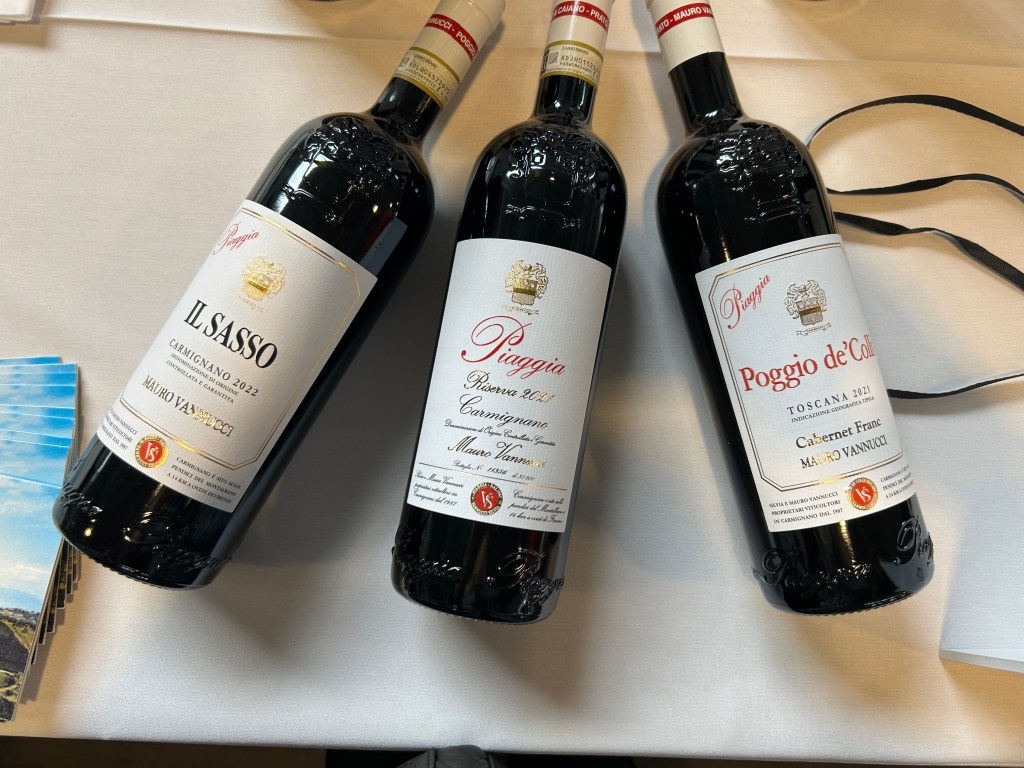
2022Il Sasso Carmignano, Mauro VannucciJS 92$3580% Sangiovese, 20% Cabernet Sauvignon
2019Brunello di Montalcino Poggiarelli, CortonesiJS 91$35100% Sangiovese
2019Brunello di Montalcino La Mannella, CortonesiN/A$69100% Sangiovese
2016Brunello di Montalcino La Mannella Riserva, CortonesiN/A$69100% Sangiovese
2021Nizza Le Court Riserva, Michele ChiarloWE 94$50100% Barbera
2020Barolo Cerequio, Michele ChiarloWE 94$124100% Nebbiolo
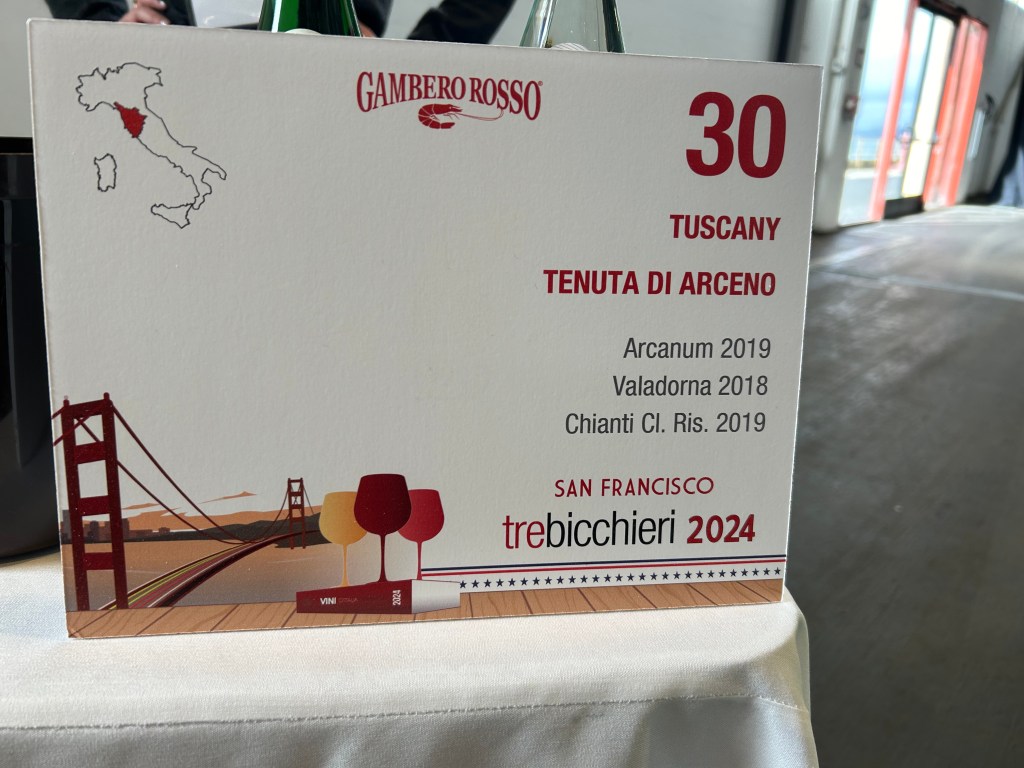
2019Tenuta di Arceno ArcanumRP 93$5265% Cabernet Franc, 20% Merlot, 15% Cabernet Sauvignon
2020Tenuta di Arceno Chianti Classico RiservaWS 94$40100% Sangiovese
2018Tenuta di Arceno ValadornaRP 95$120100% Merlot
2020Renato Ratti Barolo SerradenariN/A$180100% Nebbiolo
2020Renato Ratti Barolo MarcenascoJD 93$75100% Nebbiolo
2022Renato Ratti Langhe NebbioloN/A$27100% Nebbiolo
2020Giovanni Sordo Barolo PernoWE 90$65100% Nebbiolo
2020Giovanni Sordo BaroloN/A$30100% Nebbiolo
2020Poliziano Nobile di Montepulciano Le CaggioleRV 95$70100% Sangiovese
2021Poliziano Nobile di Montepulciano AsinoneD 93$80100% Sangiovese
2021Marchesi Frescobaldi Chianti Rufina Terraelectae V. Montesodi RiservaD 95$45100% Sangiovese
2021Marchesi Frescobaldi Chianti Rufina Nipozzano V. V RiservaJS 92$3690% Sangiovese, 10% other red varieties
2022Marchesi Frescobaldi Chianti Classico Tenuta PeranoN/A$23100% Sangiovese
2021Carlo Giacosa Barbaresco AsiliJS 95$95100% Nebbiolo
2021Carlo Giacosa Barbaresco MonteficoJS 93$60100% Nebbiolo
2021Carlo Giacosa BarbarescoRV 92$37100% Nebbiolo

Key Takeaways

I intentionally omitted any wines that I wouldn’t personally buy. Every wine on this list was good, very good, or outright outstanding. What I love most is the wide range of price points—proof that great wineries can produce quality wines at multiple levels through strong viticulture and winemaking practices.

Of course, these wines only represent a small selection of what was available at the event. Italy’s wine scene is vast, spanning hundreds of regions, grape varieties, and microclimates, with incredibly talented winemakers. I only wish I had more time!

Final Thoughts

If any of these wines catch your interest, I highly encourage you to seek them out. Whether you’re a seasoned collector or just starting to explore Italian wines, you won’t be disappointed.

Let me know in the comments—have you tried any of these wines? Which Italian producers consistently impress you?

Salute! 🍷

Gambero Rosso’s ‘Tre Biccheri’ in San Francisco 2024

“Tre Bicchieri” translates to “Three Glasses” in English. It is a prestigious wine award given by the Italian wine guide, Gambero Rosso, a leading authority on Italian wine. Their annual Vini d’Italia (Wines of Italy) guide is highly regarded in the industry.

So, what does the term really mean? The “Tre Bicchieri” award is bestowed upon wines that are considered outstanding, with a rating of three glasses being the highest honor. More than 70 expert tasters comprise the team that blind-tastes 45,000+ wines annually, rating them on a scale of one to three glasses (bicchieri). Of these many thousands of wines, fewer than 1% achieve the Tre Bicchieri designation, a ranking reserved for only the best wines from each vintage. Each tour stop also includes a set of Master Classes, which spotlight different regions of Italy and the most exciting grapes and wines emerging from those regions.

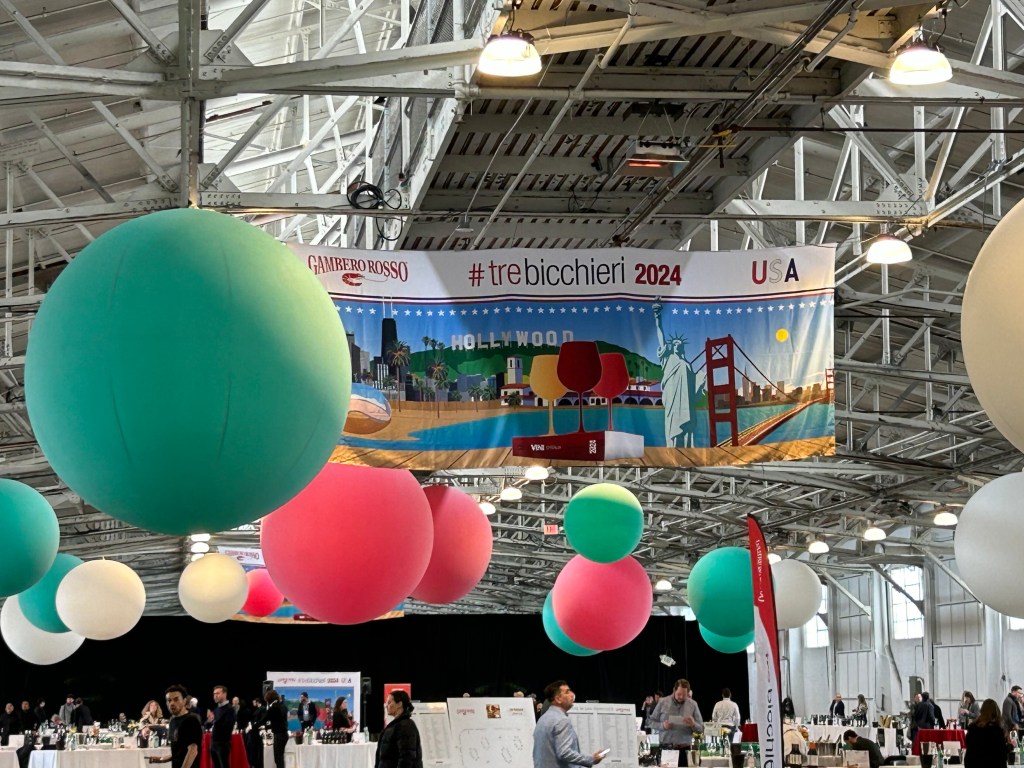
Gambero Rosso hosts events and tastings in different parts of the world, showcasing Italian wines across Italy, including those that have received the prestigious Tre Bicchieri recognition. The San Francisco tasting was held at the Fort Mason Festival Pavillion with the San Francisco Bay as the backdrop. Slated for industry professionals, it provides an opportunity to explore and appreciate the diversity and excellence of Italian wines. It also provides an opportunity for producers to showcase their wines to wine importers, wholesale buyers, retailers, restaurateurs, educators and the press. 

A wealth of information is provided by enthusiastic owners and winery representatives. In this instance, these particular wines have not yet arrived at the distributor for sale, so an advance preview of wonderful wines to come!

Three wines, same producer, different vineyards, very different aromatic profiles. A side by side tasting complete with a detailed map of the area so the representative could talk about the individual vineyards, elevation, and aspect that make these wines a standout.

There were approximately 90 tables (producers) with 2 to 4 wines at each station available to taste. It was a wonderful experience as always (I always select a theme as I cannot taste everything), and this year I concentrated my tasting on the Piedmont and Chianti areas (although I must admit I am fascinated by the 100% Cabernet Franc wines coming out of various areas in Italy and just had to sample a few).

View the list of wineries and wines at:

https://gamberorosso.us/wp-content/uploads/2024/02/folder-san-francisco.pdf

Bolgheri…tasting the stars of the Tuscan coast

The creation of Bolgheri wines began quite recently in wine history with Sassicaia created in 1968, Tignanello in 1971, and Ornellaia’s first release in 1985. They were labeled ‘Super Tuscans’ and introduced Bordeaux varieties such as Cabernet Sauvignon and Merlot to the blend. French oak barrels were utilized where Slovenian Oak was the standard. Crafting wines using varietals not allowed, the wines could only be labelled ‘vino da tavola’ (table wines) as they did not comply with DOC rules that required a high percentage of Sangiovese. These ‘rebel’ vintners brought notoriety and fame to these wines and hence the creation of Super Tuscan wines which caught the attention of premium wine consumers, particularly in the international markets. With deep color, fruity characters, spice from French oak barriques, careful use of blending across Bordeaux varietals (which piggybacked on the reputation and success of Bordeaux wines), the Super Tuscans began to achieve fame and reputation across the globe. Today, these wines are sought after by collectors and fine wine merchants around the world.

Validation of the quality and reputation came in 1994 when Bolgheri was awarded its own DOC and, in 2013 Bolgheri Sassicaia DOC was created with Sassicaia the only wine produced in the appellation.

The ability to produce these highly reputable wines is, in large part, due to the growing environment. The Bolgheri region is located on the western coast of Tuscany, with a warm Mediterranean climate but with cooling influences from the sea at night. This results in a long growing season and fully ripe grapes. The region has elevation of up to 400m but the whole region benefits, regardless of altitude, from these cooling sea influences (diurnal range, retains acidity, slow ripening for higher concentration, creating intense flavors). Rain is sufficient to grow grapes and spread throughout the season, but irrigation is also allowed. Plantings are typically high density to increase competition and naturally reduce yields. Soils are diverse and rocky much like the Left Bank of Bordeaux.

Bolgheri Sassicaia DOC has perhaps the finest reputation of them all. It is a single estate (Tenuta San Guido), and the flagship wine is Sassicaia (with Ornellaia hailing from the property right next door). These wines have soared in reputation and stand alongside the most famous Chateaux of Bordeaux.

To experience this region, I’m leading a tasting of the following wines on November 19, 2023 for the Internal Wine & Food Society. The selected wines are as follows (and listed in the order to be tasted):

2019 Michele Satta Cavaliere (100% Sangiovese) $60

2020 Gaja Ca;Marcanda Magori (65% Cabernet Franc, 35% Cabernet Sauvignon and Petit Verdot) $80

2020 Podere Grattamacco Superiore (65% Cabernet Sauvignon, 20% Merlot, 15% Sangiovese) $130

2020 Ornellaia Frescobaldi (50% Cabernet Sauvignon, 32% Merlot, 13% Cabernet Franc, 5% Petit Verdot) $270

2020 Tenuta San Guido Sassicaia (85% Cabernet Sauvignon, 15% Cabernet Franc) $270

2020 Tua Rita Per Sempre Syrah (100% Syrah) $249

2019 Antinori Tignanello (80% Sangiovese, 15% Cabernet Sauvignon, 5% Cabernet Franc) $180

We will learn about the terms Toscana and Super Tuscan and what wines fit into that category as well as Superiore. We will explore the Wine Classification system in place, how IGT began so producers did not have to label their wines as simply table wine, the bottom rung of the Italian hierarchy, as well as some of the players in this class. We will move from wines with Sangiovese in the blend to all Bordeaux varietals, and finally circle back to Tuscany with Antinori’s Tignanello, a beautiful wine.

I’ll report back after the event with what thoughts and ideas we took away from this amazing line up of cult wines!