Wine professionals are routinely asked variations of the same question: what is a reliable, reasonably priced bottle for everyday drinking? In practice, the answer often points to wines that are widely available through grocery stores and large retail channels.
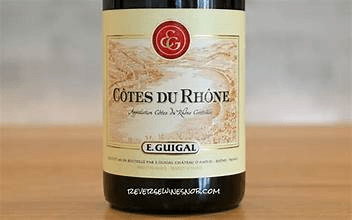
Côtes du Rhône frequently enters that conversation. The appellation offers accessibility and broad availability, but it also spans a wide range of production approaches. Not all producers operate with the same priorities.
Having long found E. Guigal’s Côtes du Rhône to perform above its price point, I began to consider what distinguishes it — and how those differences show up in the glass.
A Visit That Reframed the Wine
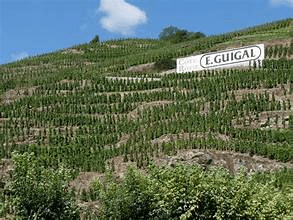
In October 2022, I stood in Ampuis tasting across the Guigal portfolio, from Côtes du Rhône through Hermitage and Côte-Rôtie.
Like many wine drinkers, I had always associated Guigal with its prestigious Côte-Rôtie bottlings — including the famed La La wines — as well as the structured expressions of the Northern Rhône.
What surprised me most that day was not the top wines.
It was the Côtes du Rhône.
The bottle most consumers encounter on grocery store shelves — often priced under twenty dollars — carried a level of structure and composure that felt distinctly connected to the house’s upper-tier wines. It did not taste like a volume-driven afterthought. It felt deliberate.
The Reality of Scale
Côtes du Rhône is one of France’s largest appellations, and supplying large retail chains requires significant volume. For many producers, the model is straightforward: maximize yields, machine harvest, ferment efficiently, and bottle early to keep inventory moving.
There is nothing inherently wrong with this approach. It produces wines that are approachable, consistent, and ready to drink.
But it is also a model built around efficiency.
Time matters. Extended aging ties up capital. Longer maceration requires labor and attention. Space in a cellar is finite. Every additional month before bottling delays revenue.
Against that backdrop, Guigal makes a different set of choices.
What Guigal Does Differently
Guigal’s Côtes du Rhône is typically led by Syrah, with Grenache and Mourvèdre playing supporting roles. That alone shapes the wine differently. Syrah brings structure, color, and aromatic lift, giving the wine a firmer backbone than many Grenache-heavy blends at this level.
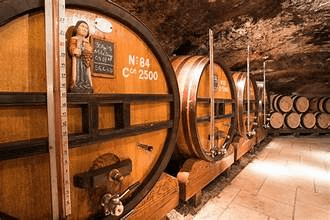
More importantly, the wine is aged for roughly eighteen months, much of it in large, seasoned oak foudres.
These large vessels don’t add obvious oak flavor. Instead, they allow the wine to evolve slowly, integrating tannins and developing texture over time. It’s a quieter influence, but an important one.
At this price point, that level of aging stands out.
It means the wine is not rushed to market. It is given time to come together.
Why It Feels Different in the Glass
When you return to the wine with this in mind, the differences become clearer.
The tannins are present but resolved. The fruit is there, but it doesn’t feel simple or one-dimensional. There’s a subtle savory edge, a sense of structure that carries through the finish.
It doesn’t just taste fruity.
It tastes complete.
That sense of integration is what often separates wines built for quick release from those given time to develop.
A Foundation, Not an Afterthought
What became clear during the tasting in Ampuis is that Guigal’s Côtes du Rhône is not treated as a separate, commercial product.
It is the foundation of the house style.
As you move up through the portfolio, the wines gain in concentration, complexity, and site expression — but they don’t feel disconnected. The same structural through-lines remain.
That continuity matters.
If the entry-level wine were simple or dilute, it would weaken the perception of everything above it. Instead, it acts as a clear introduction to how the house approaches wine.
Why This Matters on the Shelf
For consumers navigating a crowded grocery aisle, not all bottles are created equally — even within the same appellation.
Some wines are built for speed and accessibility. Others are built with a longer view, shaped by decisions that prioritize structure and integration over efficiency.
Guigal’s Côtes du Rhône shows that scale does not have to mean compromise.
It is widely available. It is reasonably priced. And yet, it reflects a set of choices that give it more shape, more balance, and more presence than many of its peers.
Final Thought
At the end of the day, the difference comes down to intent.
When a producer chooses to give even its most accessible wine time — to let it evolve, to let it settle into itself — that decision shows up in the glass.
Guigal’s Côtes du Rhône is not just an easy recommendation because of price or availability.
It’s a recommendation because it quietly delivers more than expected.
 Sudsy's Cellar
Thank you Sudsy for a very interesting article on a wine that is allowed to evolve. I can’t wait to try the wine. As always, I learned something from you.
LikeLike