The Rise of High ABV Wines: A Challenge for Napa Valley

In the midst of a global shift toward moderation in alcohol consumption, it’s hard not to raise an eyebrow at the persistence of 15.5% ABV wines — particularly from regions like Napa Valley. As consumers increasingly seek balance, freshness, and food-friendly wines, one wonders: Has Napa missed the memo?

“Elegance isn’t weakness; it’s refinement. And that may just be Napa’s next great challenge.”

There was a time when Cabernet Sauvignon from Napa struck a beautiful balance — supple, expressive, and food-compatible. Today, many bottlings surge past 15% alcohol, delivering power, yes — but also a palate burn that lingers long after the last sip. Try pairing that with a classic roast or even a modest charcuterie board, and the match often falls apart. At a recent visit, several producers spoke proudly of crafting powerful, extracted wines aligned to critical scoring systems — still chasing ratings.

So, why the stubborn trend toward elevated alcohol?

It’s partly historical. Napa’s success in the 1990s and early 2000s was built on boldness — ripe fruit, generous oak, and big scores. Critics rewarded volume and weight. But that style, while once fashionable, feels out of sync with the current wine climate — both literally and figuratively.

Climate change hasn’t helped. Warmer seasons push sugar accumulation ahead of phenolic development. Winemakers either harvest early and risk green flavors, or wait and face wines that spiral past 15.5% ABV. Without thoughtful viticulture — canopy adjustments, rootstock selection, maybe even vineyard relocation — the default path is often more alcohol.

“High alcohol isn’t just a number — it’s a sensory force that can overshadow nuance, dull acidity, and exhaust the palate.”

And yet, around the world, we see producers adapting. Burgundy’s elegance remains intact through strategic vineyard management. Champagne producers manage ripeness while preserving freshness. Even in historically warm regions like Priorat, stylistic shifts are underway toward lift and restraint.

To be fair, Napa is not static. Some producers are shifting. We see lighter expressions emerging from mountain AVAs and cooler pockets like Coombsville. But as long as high-alcohol styles are rewarded by critics and expected by collectors, many wineries remain locked into that identity.

In today’s wine culture — where sustainability, health, and food pairing matter more than ever — there’s a growing place for wines that speak softly rather than shout.

More concerning than the sheer alcohol percentage is the imbalance it creates in the glass. Alcohol is inherently sweet, and when combined with ripe fruit or residual sugar, the perception of sweetness intensifies — even in ostensibly dry wines. To compensate, many producers lean into heavier oak usage, which can impart bitterness when layered over high alcohol and dense fruit. Instead of harmony, the wine can feel fragmented — with sweetness, bitterness, and warmth competing for dominance, while acidity, the lifeline of structure and refreshment, gets lost in the mix.

“Balance doesn’t mean less — it means more of what matters: freshness, structure, and soul.”

While Napa often favors an opulent, high-alcohol style in its Cabernet Sauvignon — showcasing ripe fruit, rich tannins, and generous oak — regions such as Burgundy and many cool-climate zones in California emphasize restraint and elegance, particularly in Chardonnay and Pinot Noir. These wines offer finesse, vibrancy, and nuance. They may not shout, but they sing.

Both styles have their place. Opulence appeals to consumers who seek intensity and richness. Restraint caters to those who prefer freshness and delicacy. Importantly, neither style is inherently superior; rather, they reflect differences in climate, vineyard management, winemaking philosophy, and market demand.

With climate change driving warmer vintages and consumers seeking moderation and balance, Napa has an opportunity — and a responsibility — to evolve. We’re already seeing signs of that. A new chapter of Napa winemaking could embrace diversity of style, with both opulent and restrained Cabernets thriving side by side.


Thanksgiving Wine Pairing Guide: Budget to Luxe Picks

Thanksgiving is a time to gather with loved ones, celebrate gratitude, and savor an indulgent feast. Wine plays a crucial role in elevating the meal, complementing the rich array of flavors on the table. Whether you’re looking for an affordable crowd-pleaser, a mid-range gem, or a luxurious splurge, we’ve got you covered. Here are some recommendations for every budget.

Sparkling Wines: Welcome Friends and Family

Basic: Campo Viejo Cava Brut Reserve ($12-$15)

Cava from Spain is a vibrant, zesty white with citrus and stone fruit notes. It pairs wonderfully with turkey, stuffing, and lighter sides like green beans or salad, offering excellent value. Clean and refreshing finish with a well-balanced acidity.

Mid-Range: Roederer Estate Brut NV ($18-$24)

Roederer Estate sparkling wines are known for their complexity, elegance, and balance, much like their Champagne counterparts. Bright citrus, green apple, and pear dominate, with subtle raspberry nuances from Pinot Noir with a touch of brioche.

Splurge: Pommery Brut Royal Champagne ($55-$60)

Pale golden yellow with a fine, persistent mousse. Light to medium-bodied with a crisp, dry profile. Flavors of citrus, green apple, and white peach. An excellent introduction to the house’s refined Champagne style and a delightful choice for both casual and formal occasions.


White Wines: Perfect for Turkey and Sides

Basic: Pine Ridge Chenin Blanc + Viognier White Blend ($12-$15)

Juicy and refreshing, with flavors of ripe melon, green apple, and tropical fruits like pineapple. Known for its excellent quality-to-price ratio, this blend’s versatility makes it a fantastic pairing for various dishes:

Mid-Range: Hugel Classic Gewurztraminer ($25–$28)

This aromatic white grape is prized for its bold, floral and spicy character making it a great choice for Thanksgiving fare. Aromatic, and slightly off-dry make it a versatile pairing wine.

Splurge: Louis Jadot Chablis Fourchaume Premier Cru ($55+)

This single-varietal chardonnay wine showcases the purity and elegance of Chablis’ terroir, emphasizing freshness and minerality. Flavors of citrus zest, white peach, and crisp apple dominate, but with a creamy richness on the palate. Pure delight!


Red Wines: For the Heartier Dishes – Beaujolais Anyone?

Basic: Georges Duboeuf Beaujolais Nouveau ($10–$15)

Fresh, fruity, and easy-drinking, Beaujolais Nouveau is a classic choice for Thanksgiving. Its light body and vibrant red fruit notes harmonize with cranberry sauce and roasted turkey.

Mid-Range: Chateau des Deduits Fleurie Beaujolais ($22-$25)

Fleurie, known as the ‘Queen of Beaujolais Crus,’ produces wines that are typically lighter, fragrant, and more delicate than some of the other Crus. Floral hints of violets and roses, with subtle earthy and spicy notes such as white pepper and a touch of licorice.

Splurge: Domaine Jean Foillard Morgon Cote du Py Beaujolais ($52+)

Morgon is one of the 10 Crus of Beaujolais, known for producing structured, age-worthy wines. Ripe red and dark fruits, cherry, raspberry, and blackcurrant with earthy notes of wet stone, forest floor, and subtle mushroom.


more red wines: Pinot noir to please

Basic: Four Graces Pinot Noir Willamette Valley ($12-$25)

Medium-bodied with a smooth, velvety texture. Fresh red fruit flavors of cranberry, cherry, and plum and an earthy complexity balanced with vibrant acidity.

Mid-Range: Roserock by Drouhin Oregon Eola-Amity Hills Pinot Noir ($40+)

This wine is an exceptional expression of Oregon terroir, combining the finesse of Burgundy with the distinct characteristics of the Eola-Amity Hills. It’s a refined, balanced Pinot Noir that offers both elegance and depth, making it perfect for those who appreciate both the new world and old world styles of Pinot Noir. Elegant and complex, showcasing a beautiful balance of fruit, earthiness, and subtle spice

Splurge: Louis Jadot Santenay Clos de Malte, Burgundy ($55-$60)

Clos de Malte: This specific vineyard, classified as a Premier Cru, is a monopole (single-vineyard site) owned by Louis Jadot. The terroir of Clos de Malte is particularly favored for its warm, south-facing exposure, ensuring that the grapes ripen fully while maintaining good acidity. A classic Burgundy Pinot Noir, offering a beautiful balance of fruit, earth, and spice.


Dessert Wines: The Grand Finale

Basic: Croft Reserve Tawny Porto ($20-$25)

A classic, well-balanced Tawny Port with rich dried fruit, nutty flavors, and a smooth, velvety texture. Reserve Tawny Port: This is typically a blend of Ports aged in oak for around 5 to 7 years, though it can vary slightly.

Mid-Range: Graham’s 10 yr. Tawny Port ($30+)

The Graham’s 10 Year Old Tawny Port is a standout in the category of aged Tawny Ports, offering a refined balance of fruit, nutty flavors, and the signature complexity that comes with extended aging in oak barrels. This Port is aged in oak barrels for a minimum of 10 years, which gives it more time to oxidize and integrate the oak’s influence. Over this extended aging period, the wine develops more complex flavors, including nutty, caramel, and dried fruit notes. It becomes smoother, with a more pronounced aged character compared to Reserve Tawny.

Splurge: Graham’s 20 yr. Tawny ($70+)

Graham’s 20 Year Old Tawny Port is a luxurious, complex wine that exemplifies the finesse of long aging in oak barrels. With its rich flavors of dried fruit, caramel, nuts, and spices, it represents a perfect balance of sweetness and acidity. This Tawny Port offers an elegant, velvety texture and a long, satisfying finish, making it an ideal choice for special occasions, or as an after-dinner treat. It is particularly delightful when paired with rich cheeses, decadent desserts, or simply enjoyed on its own.


Tips for Thanksgiving Wine Pairing

  1. Offer Variety: Provide at least one white, one red, and possibly a sparkling wine to cater to diverse tastes.
  2. Consider Acidity: Wines with higher acidity pair well with Thanksgiving dishes’ rich and sweet flavors.
  3. Chill Reds Slightly: Serving reds slightly cooler than room temperature helps highlight their fruitiness (think 60-65 degrees as the wine will warm as it sits in the glass).
  4. No tannins: Tannic wines, which are wines high in tannins (like Cabernet Sauvignon, Nebbiolo, or Syrah), tend not to pair well with many traditional Thanksgiving foods. For Thanksgiving, wines with lower tannin levels and more balance—such as Pinot Noir, Gamay (Beaujolais), Chardonnay, or Riesling—tend to be more successful. These wines complement the meal’s diverse flavors without overwhelming any single component, making them versatile choices for a wide range of traditional Thanksgiving dishes.

No matter your budget, the right wine can transform your Thanksgiving meal into an unforgettable celebration. Cheers to making memories and savoring every sip!

Happy Thanksgiving!

Fraternal Wine Organizations have a lot to offer…

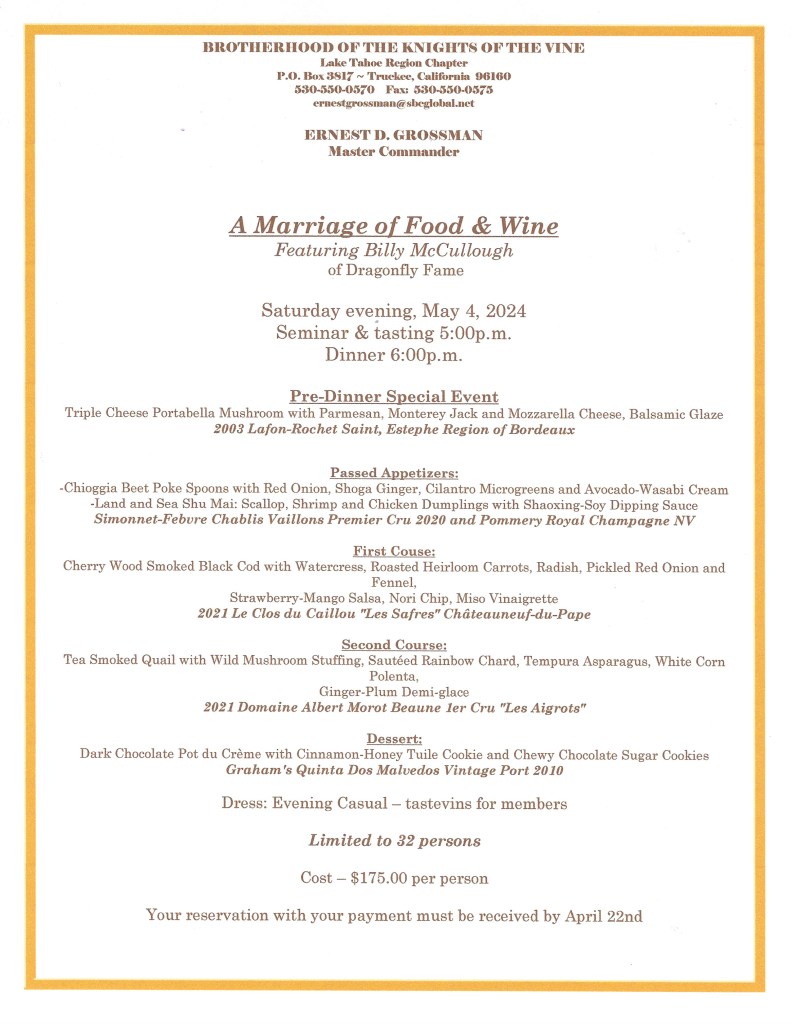
The Knights of the Vine (KOV) Lake Tahoe hosted an innovative food and wine pairing event at the home of Commander Ernest Grossman in Truckee, California, on the snowy evening of May 4, 2024. Billy McCullough, former owner/chef of the Dragonfly Restaurant, crafted the menu, presenting creative cuisine with an Asian flair, and I had the honor of pairing the food with delicious wines for the evening.

Ernie, in his thoughtful and generous manner, gifted a couple of bottles of the 2003 Lafon-Rochet Bordeaux from his personal cellar for a mini-educational event. The 20 year old wine was kept at 60 degrees to help lift the acid and show the brightness of the fruit. Gratefully, we found the corks to be pliable with no evidence of leakage, so we carefully decanted to remove any sediment. Then, the deeply colored wine was poured into glasses to rest for several minutes and to allow any reductive aromas to blow off. It was indeed an old beauty in the glass. Deep ruby/purple core fading to a more garnet hue at the edges, an initial whiff of raisin faded to ripe black plum, blackberries, licorice, acid was medium plus and alcohol was still well integrated in the wine. The finish was surprisingly long. It was a delight and a great educational experience to show patience when opening old beauties!

Moving to the appetizer course, the Pommery Royal Champagne NV was amazing with the poke spoons and dumplings. The Champagne showed lemon chiffon and creme brulee aromas, very fresh lemony fruit, and the lightness of the sparkling wine on the palate was a perfect pairing for these amazing nibbles.

Next came the Cod…

A beautiful, creative presentation of perfectly prepared, almost blackened, cod smoked on cherry wood and presented with grilled vegetables and strawberry salsa. I paired this with a Chateauneuf du Pape drawing toward the smoked cherry wood and strawberry salsa, and of course, with consideration as to where it stood in the line-up of dishes for the evening. The Grenache element in this wine definitely sang to the smoked and fresh strawberry elements, and the Cod itself was meaty so the weight and texture also worked beautifully.

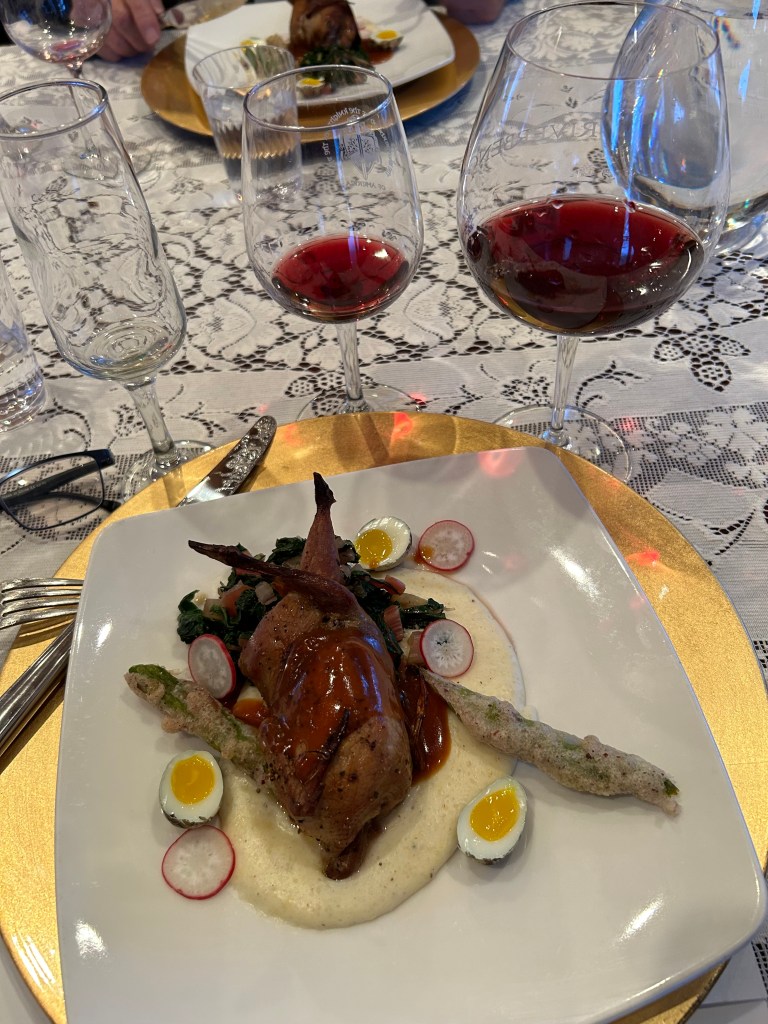
Tea smoke Quail came next, surrounded by Quail eggs, with mushroom stuffing completing the Quail, all on a bed of polenta. The Premier Cru Burgundy from Domaine Albert Morat absolutely sang with this dish, drawing to a pepper element in both the food and wine. This proved to be ‘off the charts’ amazing and I believe it was the favorite pairing of the evening.

To play to an educational moment, we had both the Chateauneuf and the Burgundy poured at the same time so that guests could try each wine with each of these two courses. It was fun to find that everyone liked the pairings presented, but appreciated the opportunity to try it themselves. We also talked about the depth of color of the Chateauneuf vs. the Burgundy, pointing out that often people think the darker the color the more aromatic the wine. However, while the Chateauneuf du Pape was ruby/purple and more intensely colored, that was due to the thick skinned grape varieties like the Syrah which is part of the blend. The Burgundy, on the other hand, while it was ruby/garnet but had less depth of color (typical of thin skinned varietals), was intensely aromatic, as much so as the Chateauneuf.

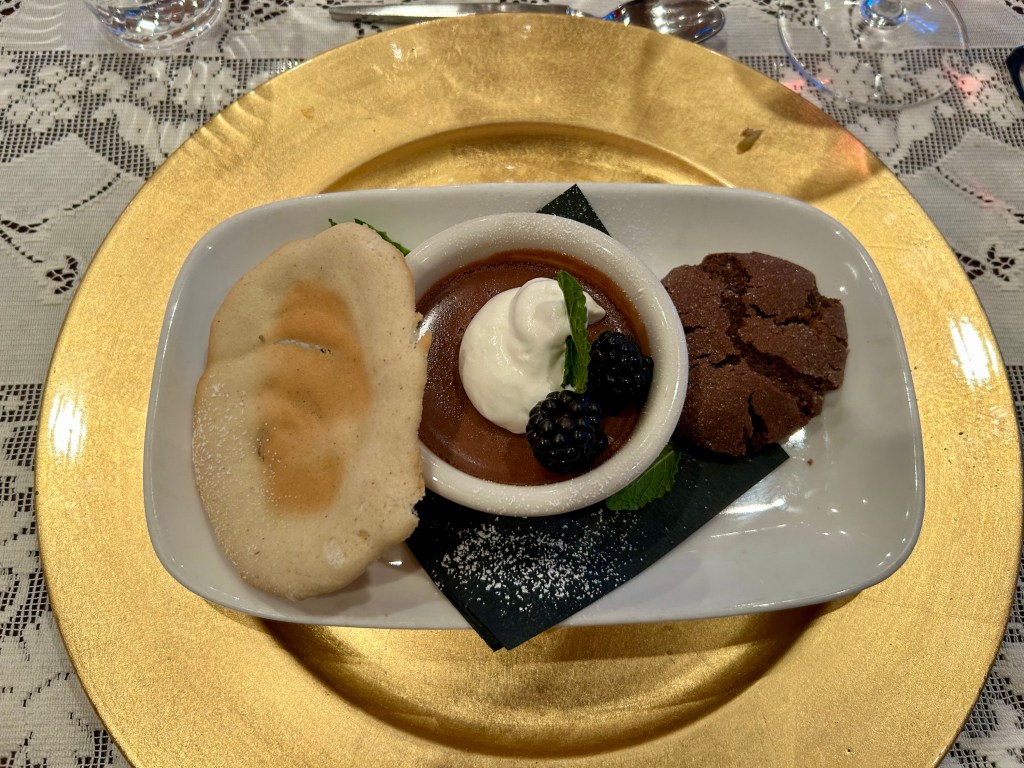
I generally skip dessert, but not tonight. This was an amazing combination of texture and flavors as well as candy for the eyes. All seamlessly paired with the delicious vintage port from Graham’s and most of us went back for more. While quite the hearty dessert, Chef Billy spoiled us all by bringing plates of additional ‘cookies’ to each table for our enjoyment, not to mention second pours of the lovely port wine.

It was a fantastic dinner as well as an educational opportunity, tainted only by a rouge spring snowstorm that kept many of our friends home due to road closures. While we we missed them dearly, this will be a dinner to remember as well as ‘snowageddon’ which came out to play when not invited.

If you love wine and food and want to surround yourselves with like thinking people, I encourage you to check out the Knights of the Vine (KOV) at: http://www.kov.org

There are many chapters around the country and more organizations to check out through the F.I.C.B. organization at: https://winebrotherhoods.org/en/

What fun and delicious wines will grace your Thanksgiving table?

I am certainly looking forward to enjoying Thanksgiving Dinner with family and friends. However, I am going to change up the wine offerings this year. As the dishes served are standard Thanksgiving fare offered and anticipated as well as those family favorites, I do not want to mess with the menu or the family ‘food traditions.’

To keep it simple, I will be serving the following:

For the happy hour (before the serious eating commences):

Veuve Cliquot Demi Sec NV – this Champagne is lush on the palate and has enough sweetness to soften the acidity with just a touch of yeasty character. The mousse is lively and gives the champagne a delightful crispness not expected in a demi sec. The aromas and flavors evoke peach, caramel, pear, and Meyer lemon, which linger beautifully, and the finale is a long, pleasant finish. It is a delightful Champagne and will please both connoisseurs as well as those new to this style.

I recently purchased this at Total Wine & More for $65 for a 750ml bottle (with the ‘buy six’ discount). If you do not need a whole bottle, it is also available in a half bottle size (www.wine.com). Serving in a beautiful champagne flute or Grandma’s cut crystal will add elegance and scream festive! This beautiful wine is a combination of Pinot Noir, with Chardonnay, Meunier, and reserve wines from the cellar. It hails from the Champagne region of France.

At the table, I will be serving a white and a red wine:

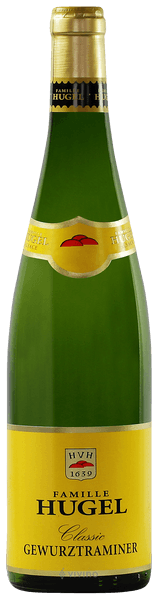
Famille Hugel Classic Gewurztraminer 2019 (or slightly older) – this white wine beauty from the Alsace region of France is an aromatic variety that delivers tropical fruit, peach, pear, melon, honey, ginger and exhibits notable minerality. The wine is clean and fresh with a spicy element to complement all those savoy flavors present in Thanksgiving fare. It has great weight on the palate and offer low acidity, so it will not overpower the savory elements of your meal. If making a simple salad, you can also use this Gewurztraminer as the ‘acid’ part of your salad dressing, adding it to extra virgin olive oil and spices of your choice.

I recently tasted this in Alsace in the town of Riquewihr at the Hugel Family winery tasting room. You can purchase it easily through www.vinvino.com or at Raley’s markets. The price ranges from $23 to $26 per bottle.

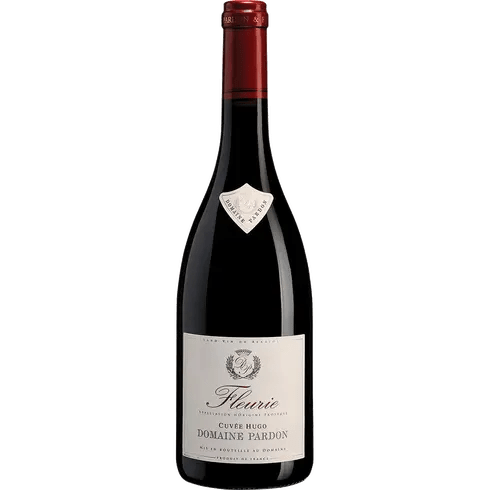
Domaine Pardon Cuvee Hugo Fleurie 2020 – this is not the Noveau Beaujolais wine released on the 3rd Thursday in November each year. This is a serious Gamay wine crafted from the vineyards in the North of Beaujolais in the Cru of Fleurie (there are 10 Crus in Beaujolais making delicious wines). I recently paired this wine for an event where the driving element of the main dish was the spice, Saffron. It absolutely sang with the food, and I know it will do the same with your Thanksgiving meal. It has just enough tart raspberry and cranberry elements coupled with a spicy and earthy finish for all those delicious, crazy flavors in our American Thanksgiving extravaganza. While aromatic and flavorful, the wine offers a light to medium body and the acidity keeps the palate fresh and lively.

Often, Gamay from Beaujolais will rival Pinot Noir at about one-third the price. The wine does not have an overabundance of tannin, so it is a very versatile food wine. I purchased this at Total Wine & More for $23 (with the ‘buy six’ discount).

For dessert:

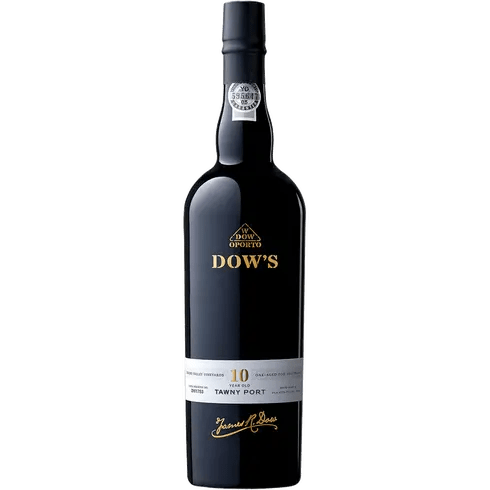
Dow’s 10 Year Tawny Port – while there are many amazing dessert type wines, after such a big meal with a menagerie of textures and flavors, and a glance at the dessert table which may include pumpkin, pecan, and apple pies, something with enough flavor and just rich enough will set the tone and finish your dinner. Dow’s port will not disappoint and will give just enough bang for the finale. The wine exhibits aromas and flavors of dried apricot, baked cherries, plum cake with a definite nutty characteristic. It is aged in oak barrels and is a blend of older wines that are an average of 10 years.

I have used this port wine for many events, and it is a bargain at around $30 a bottle. I found it at Save Mart, www.wine.com and Total Wine.

While there are many wines available that will give you a great pairing experience, I hope you will try one or more of these recommendations. Remember, there are no absolutes when pairing wine and food but many variables. Those include the food and the elements in the dish but most importantly, the people you love and are hoping to please.

Happy Thanksgiving!

Navigating the World of Bubbles…

Do you feel special when someone hands you a glass of bubbly wine in a pretty flute?  It is festive and fun…and totally confusing when you are tasked with the job of purchasing sparkling wine for a holiday party, dinner or just because.  To make your selection easier, let us look at some sparkling wine basics to enable you to buy with a measure of confidence.

First, you are asked to buy ‘Champagne’ because that term is just like every tissue is called a ‘Kleenex.’ To cull the herd of production styles of wine, we will limit this to sparkling wine crafted by the time honored ‘traditional method’ (there is also sparkling wine made by tank method – Prosecco, for example – and others by infusing with carbonation, but, these, in my opinion, while less expensive, can be less satisfying products).

While still wine is made by vintage (whatever the growing year gives you is what goes into the bottle), sparkling wine is made by formula.  Using the traditional method of production, winemaking begins with just ripe grapes that are fermented and a base wine made from that vintage.  Each sparkling house will have many iterations of base wines (varying vintages, different vineyard sites, high vs. low elevation grown fruit, different blends, etc.) and will use these to craft their house style base wine each year.  This base wine is then put into bottles (the same bottles that the sparkling wine is later sold) along with the tirage (sugar and yeast, yeast nutrients and a clarification agent) for the secondary fermentation.  The amount of sugar added at this step depends upon the degree of effervescence required and is what creates those lovely bubbles in the glass.

The bottles are sealed with crown caps (like beer bottle caps), placed on their sides to wait for fermentation to complete, and then the winemaker chooses if the wines will age on the lees and for what length of time.  If Cava is being produced, a minimum of 9 months is required but more typical is 15 to 18 months at which point the effects of autolysis becomes detectable.  (Autolysis is the enzymatic breakdown of dead yeast cells which adds the yeasty, bread dough, brioche, hazelnut character and a creamy texture.) The length of time depends upon the style of sparkling (fresh fruit vs. lees-aged character) but autolysis can continue for 4 to 5 years and has been known to last for 10 years.  That certainly adds to the cost of that special bottle!

After ageing on the lees, the bottles, stored on their sides, are riddled (turned toward the vertical so that the lees flocculate and eventually end up in a mass in the neck of the bottle), the necks are cooled, crown caps removed and the frozen chunks of yeast are ejected.  Dosage is added (a mixture of wine and sugar) and this step will dictate the sweetness of the final wine.  A cork, wire muzzle and metal capsule are then put in place.

As you can see, a ‘traditional method’ sparkling wine is not like buying a bottle of Pepsi or Coca Cola, products that are the same each production.  The choices made during winemaking such as varietals used, tirage, dosage, lees ageing, and additions have a direct impact on the character of the wine.

If you are looking to purchase a ‘traditional method’ sparkling wine, you might find the following choices (this is not all inclusive but representative of what you might find on your wine shop shelves or local grocer):

  • Champagne – from France and the region of Champagne made from Chardonnay, Pinot Noir and Meunier, the Champagne varietals (Note:  you might also find ‘California Champagne’ but it’s not from France and the allowed usage of the term is the result of an oversight when a treaty was signed years ago)
  • Crémant – French sparkling wine made by the traditional method from varietals typically grown in the region of production (Alsace, Burgundy, Loire, Bordeaux, Jura, Die, Limoux, Savoie).  This can include Chenin Blanc, Cabernet Franc, etc., depending on the area
  • Cava – Spanish sparkling wine made using Macabeo, Parrallada, Xarel-lo and Chardonnay varietals
  • Sparkling Wine from USA – made in many states and from various varietals
  • Franciacorta – Italy – made from Chardonnay and Pinot Noir varietals
  • Cap Classique – South Africa – made from Champagne varietals, Chenin Blanc, and Pinotage
  • Sparkling Wine from Tasmania – from Australia using Champagne varietals

If you decide upon the area of Champagne (or the pretty bottle), you need to check the style.  The most notable choices:

  • NV – non vintage which is sparkling made from a few vintages and represents the style of the house
  • Vintage – 100% from the vintage and can be house style or a unique blend
  • Rosé – a blend of red and white grapes
  • Blanc de Blancs – only white grapes used
  • Blanc de Noirs – white sparkling from red fruit with a fuller body

For French Champagne, you may also see:

  • Grand Cru – all grapes are within the vineyards of Grand Cru Villages
  • Premier Cru – all grapes from within Premier Cru Villages
  • Prestige Cuvee – the producer’s top wine which can be NV or Vintage

Note:  be aware that ALL houses within these Cru Villages can call their Champagne a Grand or Premier Cru even if they are not a premium producer.  It is simply a designation which is hooked to the village of production and not a guarantee of quality.

Finally, how dry, or sweet of a sparkling wine are you looking for?  It seems that a great majority of the offerings are BRUT which means they are anywhere from zero to 12 g/L.  These will taste dry to slightly off dry but not have a lot of sweetness showing, especially if the wine has spent time on the lees.  In my experience, BRUT is what is most often purchased.  If a bit more sweetness and roundness is desired, the EXTRA BRUT category is a step up providing 12 to 17 g/L.

If you decide upon a Crémant, you will definitely reduce the cost of the bottle and open yourself up to an interesting world of sparkling wine made from different varietals, although still French.  Note that Alsace, Loire, and Burgundy are the main and the most famous regions.  I am particularly a fan of Crémant d’Loire as I enjoy the Cabernet Franc and Chenin Blanc present in the mix of varietals. 

While impossible to sing the virtues of all the many choices, the following are wines I recently used for a sparkling educational tasting along with food pairings:

Campo Viejo Gran Reserva Cava – Spain – Manchego Cheese, Marcona Almonds, Olives and Crusty Bread/Crackers

Champalou Brut Vouvray (Loire) Crémant – France – Gruyere, Salami, French Bread

Mumm Napa Brut Reserve Sparkling – USA – Crab and Shrimp Bisque

Roederer Estate Brut Anderson Valley Sparkling – USA – Lobster Mac ‘n Cheese

Nicolas Feuillatte Reserve Exclusive Brut Champagne – France – Triple Cream Brie with Crostini

Martini & Rossi Asti Sparkling – Italy – Biscotti with Yogurt Covered Almonds

All of these wines are made by the Traditional Method except for the Asti which is made by the Asti Method, a variation of the tank method, which was a fun and surprising way to end the tasting with a bit of sweetness. 

So, if you feel special when someone hands you a glass of bubbly wine in a pretty flute, try exploring the vast world of bubbles.  Unless you are simply looking to add orange juice (think Prosecco) to the glass, get out there and enjoy navigating the world of bubbles!