Burgundy, Demystified: Why I’m Starting This Journey

Burgundy has a reputation—and in many ways, it has earned it. At its finest, Pinot Noir from Burgundy can be extraordinary: nuanced, layered, and capable of expressing place with a level of precision that few wines achieve.

It is also, quite often, scarce, highly allocated, and expensive.

The most sought-after bottles are produced in small quantities, distributed selectively, and frequently priced well beyond what most of us would consider everyday drinking. Availability can vary widely depending on your market, and even when accessible, these wines tend to be reserved for special occasions.

But Burgundy is not only about its most famous—and expensive—bottlings.

For those of us who love wine but live in the real world, Burgundy offers a range of tiers that are not only more accessible, but also deeply worth exploring.


Understanding the Layers

At its simplest, Burgundy is structured as a hierarchy:

  • Bourgogne AOC
  • Village wines (e.g., Pommard, Volnay, Savigny-lès-Beaune)
  • Premier Cru (1er Cru)
  • Grand Cru

From broadest to most specific, these tiers reflect increasing geographic focus and, in theory, increasing quality.

But as I’ve come to appreciate, classification alone tells only part of the story.

What lives behind a Bourgogne label—or any Burgundy label—can vary considerably. Vineyard sourcing, vine age, farming decisions, and winemaking choices all play a role in shaping the final wine. Two wines with the same classification can deliver very different experiences in the glass.

That idea is what led me down this path.


Why Start at Bourgogne?

In the first installment of this exploration, I chose to begin at the Bourgogne level—not because it represents the simplest wines, but because it offers one of the most interesting opportunities for discovery.

Rather than focusing on larger producers such as Louis Jadot or Domaine Faiveley—both of which produce excellent wines—I narrowed my focus to smaller producers. This is not a question of quality, but of flexibility.

At larger production levels, consistency becomes the priority. House style must be maintained across varying vineyard sources and vintages, which can limit the degree of adaptation in the cellar.

Smaller producers, by contrast, often have the ability to work more closely with their fruit—adjusting extraction, élevage, and blending decisions depending on what each vintage and vineyard parcel offers. In some cases, fruit from higher-tier vineyards may even be declassified into Bourgogne-level wines, adding an additional layer of interest.

The result can be wines that quietly exceed expectations, not by trying to be something they are not, but by being handled with care and intention.


Burgundy for Everyday Drinking

The Bourgogne AOC level also serves a practical purpose.

These wines allow for regular enjoyment. While they are not inexpensive, they are generally priced below many comparable wines from regions such as Napa Valley—particularly Cabernet Sauvignon—and, in my view, often offer greater versatility at the table.

There is a freshness, a sense of balance, and a natural affinity for food that makes them particularly compelling for everyday drinking.


A Different Way to Explore Burgundy

As I began to think more intentionally about how to approach Burgundy, one idea kept coming into focus:

Where is the sweet spot?

Not the most expensive wines.
Not the most famous vineyards.

But the wines that, for a variety of reasons, deliver more than their classification and price might suggest.

This perspective—looking for wines that overdeliver through thoughtful sourcing, careful winemaking, or a combination of both—will guide the series that follows.
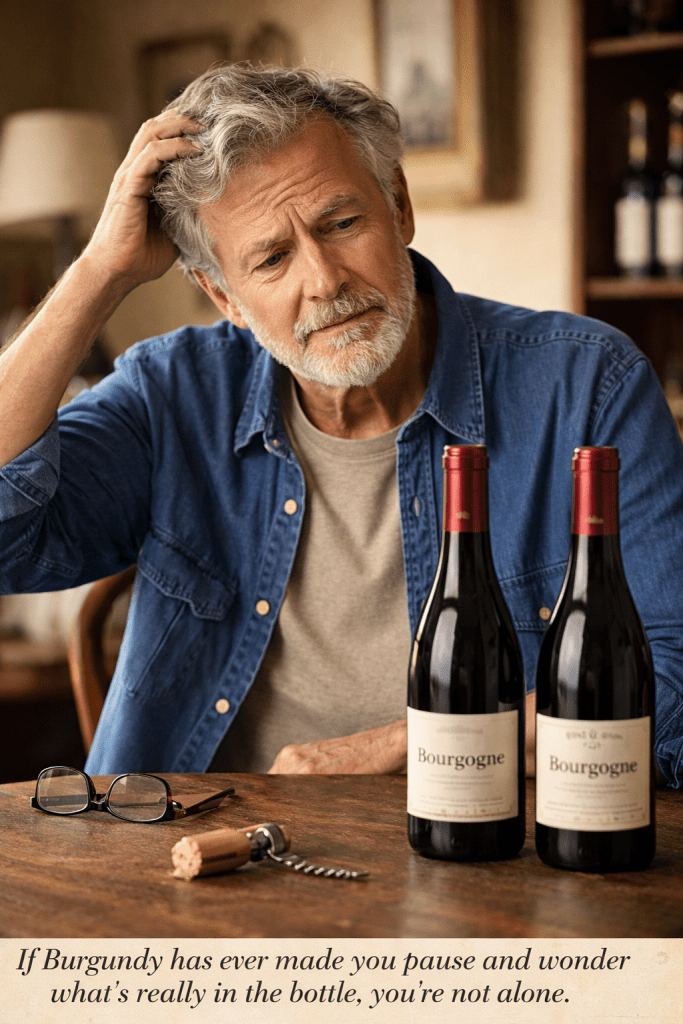
It’s a fair question—and one that Burgundy doesn’t always answer easily.


Looking Ahead

Over the coming months, I’ll be exploring Burgundy through this lens—moving from Bourgogne to Village and Premier Cru, and examining where wines truly exceed expectations at each level.

Each installment will focus on a small number of wines, allowing for a closer look at how decisions in vineyard and cellar shape what ultimately ends up in the glass.

Burgundy can feel complex, even intimidating. But it doesn’t need to be.

By starting at the broader end of the spectrum and working upward, the goal is not only to understand the wines more clearly, but to identify where real enjoyment—and real value—can still be found.

Look for the first installment in April:
Finding the Sweet Spot: Bourgogne AOC.
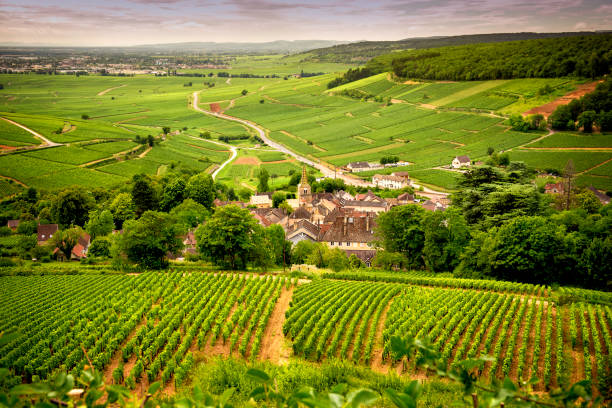
Burgundy’s Quiet Shift: From Extraction to Infusion

Why many Burgundian winemakers are stepping back in the cellar to reveal Pinot Noir’s true character.

Across Burgundy, a subtle change is taking place. Instead of extracting more from Pinot Noir, many winemakers are discovering that patience in the cellar may reveal even more about the vineyard.


A Personal Observation

While preparing several Burgundy masterclasses for 2026, I found myself thinking about how much the conversation around Pinot Noir has changed over the past two decades. When I first began studying Burgundy, much of the technical discussion centered on extraction—how winemakers managed fermentation to build structure and ageability.

Today, however, many producers speak about something quite different: infusion.

The shift may sound subtle, but it reflects a meaningful evolution in how Burgundy’s winemakers approach the cellar.


Extraction vs. Infusion

In wine, meaningful changes rarely announce themselves loudly. More often, they appear gradually—one cellar decision at a time—until suddenly the style of an entire region feels different.

In Burgundy, that shift is happening now.

For decades, discussions about red Burgundy centered on extraction: how much color, tannin, and structure could be drawn from Pinot Noir’s thin skins during fermentation.

Punch-downs, pump-overs, and maceration length were tools used to shape wines that would age gracefully and develop complexity over time.

Historically, extraction in Burgundy was not simply stylistic but practical. In cooler vintages, winemakers often needed to work the cap more actively to build sufficient color and structure from Pinot Noir’s naturally thin skins.

But today, a different philosophy is quietly taking hold across the Côte d’Or. Increasingly, winemakers speak not about extraction, but about infusion.

Extraction implies force. It suggests actively drawing phenolics—color, tannin, and flavor—from the skins during fermentation.

Infusion, by contrast, is a more patient approach. Instead of aggressively working the cap of skins and stems that rises during fermentation, many producers now favor a gentler method. The goal is to allow the wine to gradually absorb structure and aromatics rather than pulling them out through mechanical intervention.

The difference may sound subtle, but in the glass it can be profound.

Infusion often yields wines that feel more transparent and aromatic, with tannins that are fine-grained rather than muscular. Instead of emphasizing power, the wines emphasize nuance.


Infusion and the Shape of Tannins

Another way to think about the difference between extraction and infusion is through the shape of tannins.

Extraction tends to emphasize quantity. Techniques such as frequent punch-downs or aggressive cap management draw more phenolic compounds from the skins and seeds, often creating wines with firmer, more assertive tannic structure.

Infusion, by contrast, is less about how much tannin enters the wine and more about how those tannins integrate. When phenolics dissolve gradually during fermentation—rather than being actively forced out—the resulting tannins can feel finer, more supple, and more evenly woven into the wine.

In practical terms, the wine may not contain less tannin. Instead, the tannins feel different: less angular, more layered, and often more transparent to the vineyard character beneath them.

Because infusion slows the extraction process, it also gives the winemaker more time to observe how the wine is evolving during fermentation. Rather than forcing structure early, the cellar team can allow the wine to develop gradually and intervene only when necessary.

For Pinot Noir, a grape variety prized for its ability to express place, this difference can be critical. The goal is not to eliminate structure, but to shape it in a way that supports the wine rather than dominating it.


Infusion isn’t about extracting less from Pinot Noir — it’s about shaping the tannins differently.


Whole Cluster: Not Just a Beaujolais Technique

The use of whole-cluster fermentation—where grape bunches are placed into the fermenter with stems intact—is sometimes mistakenly associated with Beaujolais.

In Beaujolais, whole clusters are frequently used to encourage carbonic or semi-carbonic fermentation, a process that emphasizes bright fruit and the famously playful aromas often associated with Gamay.

While both Burgundy and Beaujolais may ferment whole clusters, the intention is very different.

In Burgundy, whole-cluster fermentation primarily influences structure, aromatic lift, and fermentation dynamics rather than fruitiness alone. The intact clusters create natural channels within the fermenting must, allowing juice to circulate more gently and encouraging a slower, more gradual infusion of phenolics.

The stems themselves can contribute subtle spice, floral lift, and a distinctive structural backbone to Pinot Noir. When stems are fully ripe—as they increasingly are in warmer growing seasons—they can enhance freshness and complexity rather than introducing bitterness.

In this context, whole-cluster fermentation becomes less about fruitiness and more about texture, aromatic lift, and balance.


Why the Change?

Several forces are driving this shift.

Climate change is one of the most significant. Warmer growing seasons mean that Pinot Noir reaches phenolic ripeness more reliably than it once did. When skins and stems are already mature, there is less need to force structure through extraction.

At the same time, the next generation of Burgundian winemakers has begun taking the reins from their parents and grandparents. Many of these younger producers have inherited not only vineyards but also global demand and escalating land prices. Their challenge is not to make bigger wines, but to preserve the elegance that defines Burgundy’s identity.

In that context, restraint becomes a virtue.


A Region Defined by Patience

Burgundy has long been a region defined by nuance rather than force. As a new generation of winemakers takes the reins—while also navigating climate change, rising vineyard costs, and global demand—their response has often been to do less, not more.

The shift from extraction to infusion reflects that philosophy. Instead of shaping Pinot Noir through aggressive cellar work, many producers now allow the wine to reveal itself gradually.

In Burgundy, patience may prove to be the most powerful tool of all.


Author

Claire L. Torbeck, DipWSET, writes Sudsy’s Cellar to explore how climate, vineyard practice, and winemaking philosophy shape the wines we enjoy.